Friday, August 31, 2007

Sain bain uu! Ool zalgui, udlaa shuu! (We have not met for a long time, viewers)

I can only assume that most of you have given this blog up for dead, if only because I told you it was, back in February or so. More fool me. You see, like when Kenny met Dolly, when the material’s this good, you’ve just got to keep on singing. Islands in the stream, that is what we are. Except as we know, no man is an island. Hope that clears things up. Let us begin.

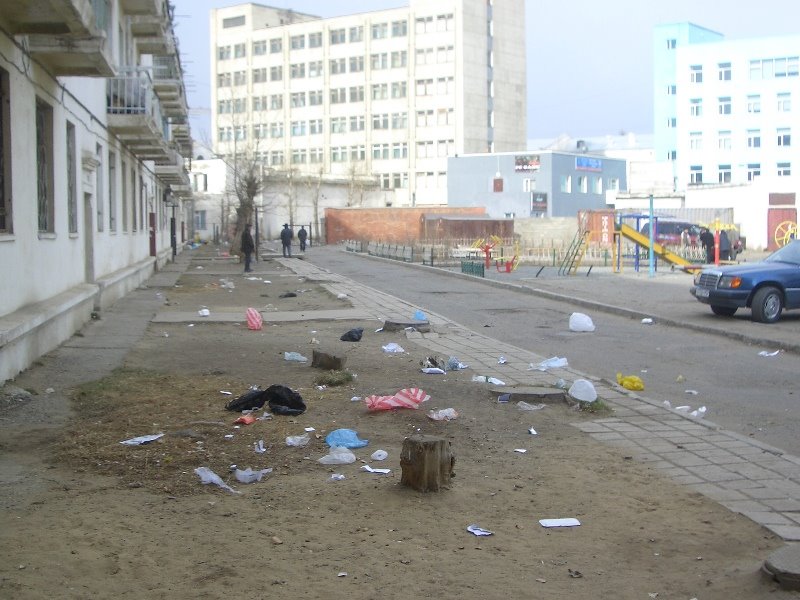
We open on the forecourt of School Number Five, usually the forgiving concrete and broken glass play space of Number Five, where 3,000 schoolkids hurl themselves around playing full contact hopscotch, flaming jumprope and ultimate fighting. This year, said kiddies are in for a surprise when the school year starts, for smack in the middle of the apron a square has been sectioned off, surrounded by spikes and iron grates.

Within the square, a mysterious black plinth has been formed. And from the navel of that, a monolith. Was Arthur C. Clarke right after all? There are no chimps around to ask. Equally mysteriously, the fellows tasked with laying the marble/polishing this plinth are distinctly lacking in most of the major Mongolian attributes. In fact, they are undoubtedly gadaadi hun, (people from outside) viewers. They appear of a more generally European persuasion, but indeterminately so. Aside from a fondness for cigarettes, they reveal no clues to their identity. What on earth is going on?

A day or so thereafter, a stern bust is placed atop the monolith. Resplendent in gold (or gold effect paint), the serious brows and mighty forehead of a man of consequence is firmly stapled to the monolith. Having stared long and hard at the fellow, his identity is as mysterious as those who put him there.

By the next day, the veil of incomprehension had been replaced with the underpants of confusion. A foreign fellow comes along with his Letraset stencils, a ruler and some gold nail polish, and paints on the front of the monolith the identity of the tenant in three languages. The gold visage who will greet youngsters as they prepare to decline the accusative is none other than Mustapha Kemal Attaturk, founder of modern Turkey and the hardest rocking bass player in history (Kerrang! Aug 1995). What is relationship is to School Number Five is still unclear. Judging from his general choleric look, he seems pretty uncertain about the whole thing as well.

Maybe he’s upset by the forbidding portcullis he’s forced to remain behind. Maybe so, because a day or so later, the ironmongery is torn up and removed, leaving six holes for poles, perhaps suitable for losing small children down.


Or maybe he doesn’t like all those people looking at him (bit of a liability for a bust, really), because, despite the cat being pretty firmly out of the bag vis a vis who this cat might be, he is then shrouded once again, rendering his once patrician visage into that of one of the Imperial Guards in Return of the Jedi, as we discovered him this morning.


What could it all mean? I await your expert analysis, viewers.

More updates on this breaking news as it happens. Any other sightings of unexplained statesmen of the 20th Century cropping up in world capitals will be reported with equal urgency.

STOP PRESS 04/09/07: It seems that the orginial portcullis was judged too unfriendly or something. In a last minute rethink, it has now been replaced by friendly yet dignified bollards, which also have the added advantage of filling in the holes in the tarmac.
Phew! A real bodice-ripper, this story. Try not to overheat.

Bi sain mit ugui (I really don’t know) viewers,

Jannie

Friday, April 20, 2007

Ella It is.


Manai naights (our friends, viewers),

We emerge from our self-imposed blog retirement for just long enough to announce the birth of daughter Eleanor Kay, known as Ella, born on 11 April in north Yorkshire. We were pipped to the post by the Pieters-Sherlocks by a full two days (see here for the annoucement of Orla's arrival), but feel certain that we'll make up the distance over the stretch.

All parties interested in expressing the joy in monetary form are encouraged to do so. Checks, phone credits, wire transfers and in-kind donations to the usual address.

On which related note, much much thanks to all of you throwing cash into the books for Mongolia hat- I am most grateful to you all, and astonished by how many of you have dived between the couch cushions and come up with the necessary. Mash ikh bayarlaa, hummus (many thanks, people).

Returning to the citadel,

Jannie

Thursday, January 18, 2007

Interregnum, or Pony Up Some Dough


Greetings viewers, U bain? As some of the keener intellects out there may have noticed, (specifically, Emily, Swith, and our mystery Settle correspondent) a six month hiatus between posts does not bode particularly well. I wish I could report it was because we were in the studio working on new material, with more keyboards and tablas than our last offering but that would not be true. Fact is, we have been distracted by such hobbies as getting pregnant and doing masterses. Seems unfair that the blog should suffer, but there you are. Either way, Time magazine (not that we read it, but um, we found one) reckons 13 million blogs were started last year, so I trust you've not been short of material. Besides, now that the kids have got hold of the internet, the whole thing's become too hip for us to keep up with. So, like the grizzled old dogs of rock we are, we're bowing out gracefully, doing a farewell tour of arenas across the world, and then we'll step off this madcap whirl which is blogs & blogging. We throw our drumsticks into your outstretched hands.

But! Before we go, I want some money.

Not for me.

However, we are running a book buying/distrbution project in 2007, whereby folks in the deep steppe with nothing to read except the ingedients list on a sack of flour weill be provided with as many kilos of books as we can score. Literacy in Mongolia is about 97 percent, but there's nothing to read. So the plan is simple. We buy books. We give them away. We do it again.

Cost to you?

A measly buck. Less than a quid. Less than a(n?) euro. Less than a New York subway token. Books are cheap in Mongolia.

So go find a dollar and then click here


You'll find us between the sanitary pad and the flipflops. Feel free to stock up on those items as well.


In the meantime, ural (a kind of blessing/good luck thing, viewers) to you all, and see you somewhere anon!

Jannie

Friday, August 04, 2006

When the grass is high....

U bain (‘sup) viewers?
This interregnum has been, to date, the longest ever hiatus this blog has yet experienced. Ochlaraai (apologies, viewers). While realizing that the readership for this piffle has now dwindled to less than a handful, we are delighted that someone actually noticed at all. So shouts-out then for Swithun, who poked us with a stick to see if we were dead or just sleeping.

Thing is, July is the all time high holiday month in Mongolia, and this year more than most. With dextrous scheduling, Mongolian holidays happen in January (Tsagaan Tsar) and July (Naadam), and last about in a week in each case. None of your long Arbor day weekend here and President’s birthday there rubbish for Mongolia. If you’re going on holiday, then make a decent muttony meal of it, and blow off the whole week. On top of which, July is the month when it begins to get genuinely hot. So between public hols and weather, it’s hard month to spend in front of a computer.

So we didn’t. First off was a sally to Lake Huvsgul, the 12th largest body of fresh water in the world, southern cousin to Lake Baikal. However, unrelenting rain meant that what should have been a easy morning’s drive from the sniggeringly entitled town of Moron to the lake’s edge turned into many rivers to cross, without so much as a Jimmy Cliff tape in the player to help us out. On our first attempt, we balked at the second river, as we would have had to cross 500 metres of floodwater against the current, a prospect less than concerting. When other cars were being hauled across by road graders, it seemed a slightly silly choice, given our lack of heavy earth moving equipment. On our second attempt the following day, what had been mighty torrents had disappeared altogether, leaving behind rocky riverbeds and tumbled trees, but no water. We had obviously imagined it all.

On we went up the western shore of the good lake, wending through forests and fording yet more rivers still in flood. It was later noticed that we were the first car to attempt the route in some days without a convoy- others had traveled up the lake by boat, having been told the road was impassable. Just goes to show what you can accomplish when you’re ignorant. The lake itself is fully splendid- as clear as a window, unspoilt by people, bereft of boats, and so clean you can wash your car with it. No wonder Mongolian Expat magazine lists it as one of the Six Places you Must Visit in Mongolia. Only doing what we’re told, viewers.

The trip, while ultimately pretty routine by Mongolian standards, was also confirmation of what we learned last Naadam: five days doesn’t get you very far in a place as big as this one, and any trip in Mongolia, no matter what the distance, will take five hours. Just will. Plan your in-ride entertainment and hydration strategy accordingly.

By being out of town, we missed the triumphant ceremonies marking the 800th anniversary of the Great Mongolian State. In 1206 (or thereabouts), Chinggis Khan (Genghis to you ill-educated out there) managed to unify the various warring tribes of Mongolia and create a credible nation which was a challenge/counterbalances to the Xi Xia in the east and the Jin in the south. From there on out, it was world domination, leaving such legacies to the world as a reopened overland route form Europe to Asia, the Forbidden City in Beijing (built by Kubilai Khan, Chinggis’s grandson), three kinds of Chinggis vodka, Chinggis beer, the Chinggis Club (three of them), Chinggis Khan international airport, and confusion to our enemies. To celebrate, all Naadam festivities were presented in multiples of 800, so there were 800 horsehead fiddlers, 800 long-song singers, 800 archers, and so on. A new and imposing statue of Chinggis was unveiled outside Parliament House, flanked by two of his generals on horseback. A few days later, 800 pieces of scaffolding were replaced as the whole edifice was 800 hours (or days) behind schedule . But hey, you don’t build a legacy 800 years strong overnight.

And finally, as a glittering finale on the 31st, geriatric German hard rock outfit the Scorpions played a gig on Sukhbataar Square. Lack of promotional material and forewarning (it was billed as a ‘surprise gig’ which is fine as long as someone knows where they should be standing to get their surprise) meant that the first our correspondent heard or saw of it was on UB television, the programming of which is esoteric enough that it was in no way surprising to find the Scorpions on it. However, nor was there anything to suggest in was happening just down the street. Imagine our surprise when last nights bleary eyed teevee watching turned into the next day’s front page. No word on whether ‘Winds of Change’ was retrofitted to include references to the siege of Samarkand.

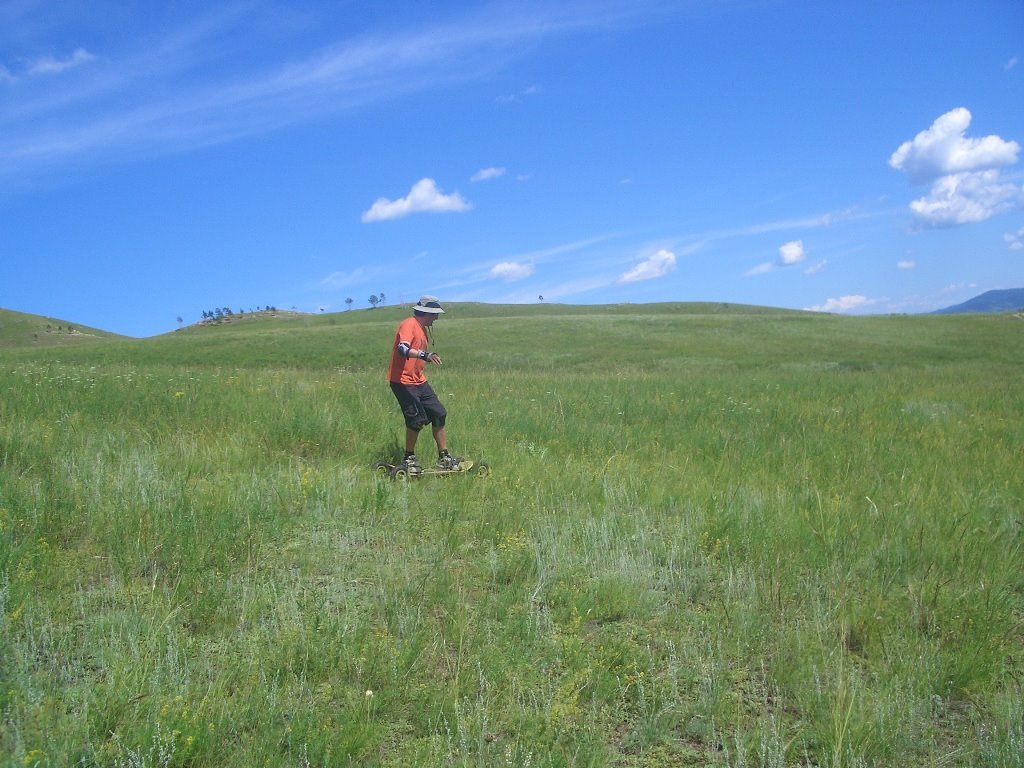
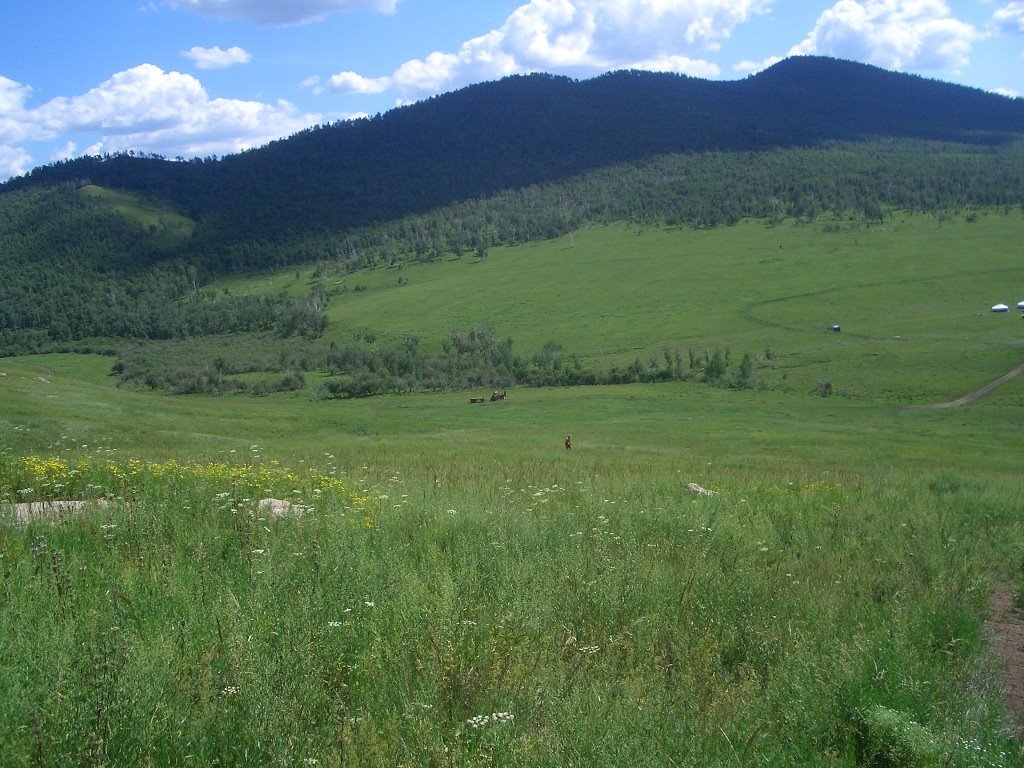
German guitars aside, the summer has also been punctuated by short, speedy zooms down unsuspecting mountain and hillsides. Back in January, getting a jump on midlife crisis issues, I parted one young Settle resident from his mountain board. For those of you uncertain about such matters, a mountain board is basically an overlong skateboard with knobbly rubber tyres, intended to help you get down that slope in double quick time. You get to the top of a hill. You get on your board. You go down it. It is, in a phrase, much much stupid fun. And a country as wavy as the ocean with limited trees. Mongolia, meet mountain board. Play nice. Having accumulated a fair selection of scratches on my pointy bits while getting to grips with this improved method of dealing with pesky downhills, I knuckled under and scored some pads last week. Within metres of first putting on protection, I hit a marmot hole full on, and tumbled ass over teakettle into the flowers, thus proving that pads aren’t just for fashion, and Poetic Justice isn’t just amovie with Janet Jackson in it.

So if in the next few weeks this blog is once again punctuated by silence and atrophy, then it’s because we are off tearing around the countryside on four small wheels. And if the wind gets up, one adds a kite to the equation, and sails across the steppe. That’s where we’ll be, viewers.


Saihan amaraaraa,

Jannie

Thursday, June 22, 2006

Our bold new direction


Greetings all-

What you see above is cover art for our new concept triple album entitled "Birthdays on the Balcony", a four hour oddessy into children's festivites with a Mongolian edge. The first disc is a challenging reworking of "John Jacob Jingleheimerschmidt" for throat singers, the second is a loop of 14 three year olds chewing carrot sticks over a reggae beat, and the final is a 27 minute free jazz rendering of Stevie Wonder's "Happy Birthday" played on horsehead fiddles and flugelhorns.

Happy birthday to Natty (tursung undri bayaring mindh hurgee, viewers), two years old yesterday.

More soon,

Jannie

Friday, May 26, 2006

One of Uaz, One of Uaz

Yamur Mashin, humuus (whatta car, viewers.)

See, there’s two things about Mongolia. One is, it’s far away. The second is, it’s really big.

Granted, it’s far away depending on where’s you’re standing, and it’s big compared to smaller things, but when you combine the two, that’s when you get a Mongolian outlook.

So there you are, looking around Mongolia and thinking such deep thoughts as “man it’s big” and “wow it’s far away”, and while your understanding of these concepts will vary depending on what kind of viewing platform you stand upon and what kind of shaded goggles you are squinting through, one thing seems certain. If you’re going to move around Mongolia, you will need a conveyance. In a word, a car.

Not just any car. Oh no. Many of your new fangled rides with their drink holders and in-seat heated bottom massagers are poor choices for the Mongolian milieu. Humvees may prowl the streets of Ulaanbaatar, but these are only vehicular bling, the equivalent of 4WD stiletto heels. Their mileage is so poor and Mongolian gas stations so far apart that taking them farther than the hairdressers is a journey fraught with peril. Plenty of Rovers, Cruisers, Troopers and Patrols exist, but if a widget pops lose from its housing when you hit a camel or something, good luck contacting your nearest dealer to help you out with the parts. So what then is the intrepid Mongolian warrior, weekend or otherwise, to drive?

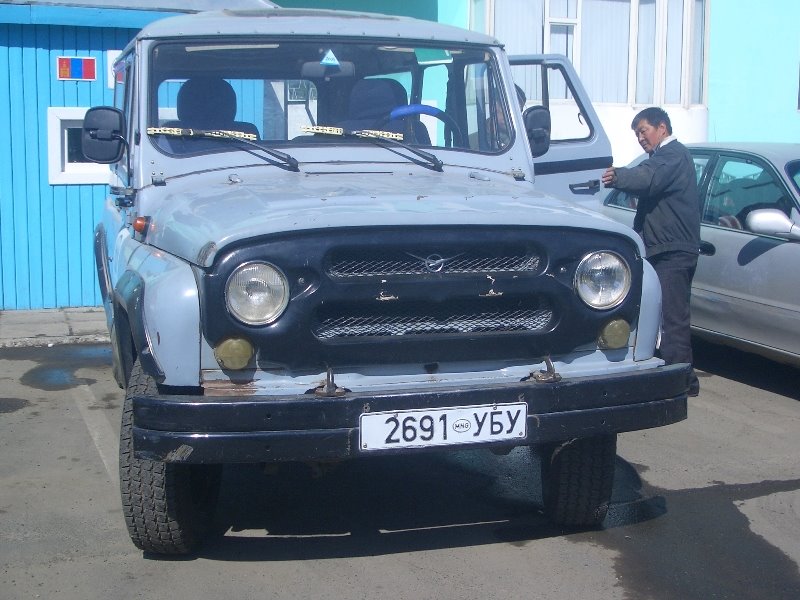
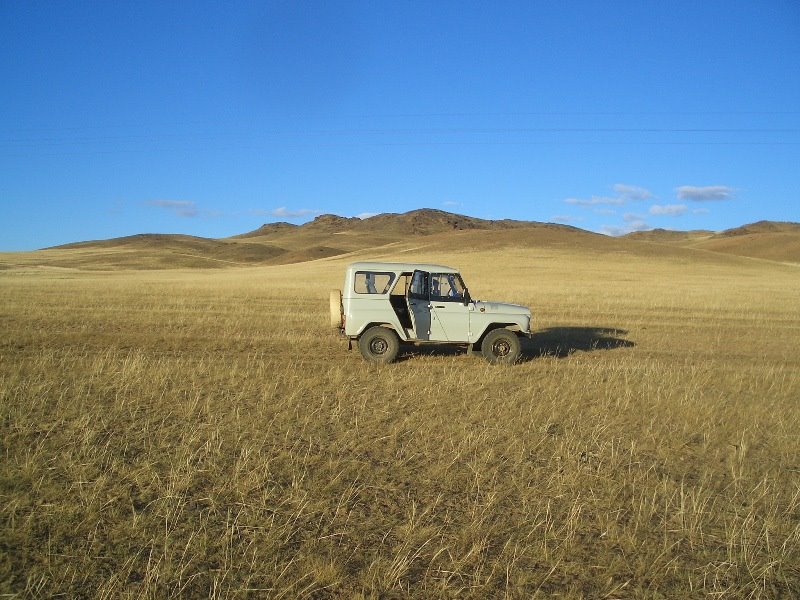
Step forward the Uaz, as car as iconic in Mongolia as the SUV in America or the Matatu in Kenya. Bata used to promote the Safari boot as ‘the Shoe that says you know Africa’. The Uaz is the Safari boot of Mongolia. Ugly as a kick in the face, made with skills as old as the hills, fixable with pantyhose and gum, and still- no other shoe (or car) sets the maidens’ hearts aflutter like a Uaz.
While you are savouring the fluid lines of the bodywork, marveling at the hardiness of the steering rack or just feeling oddly aroused by the steering wheel, a bit of history for you.

Back when it looked like the Third Reich was going to gobble up Mother Russia like so much caviar, major industries were moved out of the way of the Wehrmacht by shoveling them way inland away from the front. The ZIS car company was moved from Moscow to Ulyanovsk on the Volga where it began making cars and useful wartime items like shells. After the war, the Ulyanovsk plant was hied off into its own company, and in the 1950s they started cranking out four wheel drives according to a basic model which is still largely unchanged. This is the Uaz. Uaz is pronounced- eh., however you feel like it, really. Go nuts. It’s an acronym which stands for Ulyanovsk Avtomobilny Zavod. Russian cars have never gone in for all this fancy naming crap. There’s no Russian word for Elantra, Fabula, or Ka. An Uaz is a Uaz. Similarly, big Russian six wheel trucks are called Kamaz. Because they are made in Kamchatka, the mythical land from the game of Risk handy for invading Alaska, Japan, Irkutsk, Yakusk and Mongolia. By this logic, every car made in Detroit should be called a Daz. Which would be fine, really.
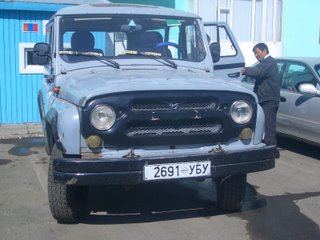
Anyway. Mostly, if you’re referring to one of these beauties in English, you’d call it a Russian Jeep. Or in Mongolian, a 69 (jahren youse, viewers), which is the model number- you know, just in case Uaz is too unspecific for you (not that there are other models, but still.) So Russian jeep UAZ 69 it is. No other ride comes close to being so vital to the country. The Uaz equivalent of a VW bus, the furgon, plays a part certainly, but all others are simply cars. The Uaz is a way of life.

Why are they so great? Well, for a start, they’re cheaper than a good horse. A boxfresh Uaz will run you between ten and fifteen grand American, and a secondhand one is considerably less. Ideally, of course, you don’t want one still in the original packaging. The whole car production process is a pretty complicated thing, and most cars come off the line with a few jagged edges here and there. You need to own a Uaz for a couple of years at least to get the transmission ground down to the point that you can shift into third, and plug up all the leaks around the doors and windows with strips of foam rubber and carpet samples so you don’t freeze in winter or suffocate in summer. A car a couple of years old is more comfortable and useful than a brand new one.

Secondly, they are engineered simply enough that anyone with a modicum of mechanical knowledge can fix them. Which is great, because by a tremendous stroke of luck, Mongolian drivers have that modicum.

At the first sign of parking, the first order of business is to clean the car inside and out with a retentiveness usually reserved for jewelers and spaceflight. While decidedly open minded when it comes to spitting, urinating and trash in public, Mongolians keep their cars clean enough inside and out that you could build silicon chips in the backseat if needs be. So first order of business when the motor is at rest is to tidy it thoroughly.

If your parking type situation persists, then its time to jack the car up and start taking bits of it apart, spreading it in a halo around the car, and peering at the constituent gubbins until inspiration strikes. The front left axle/wheel is a popular place to start, so if for any reason nothing’s actually wrong with your car, start there anyway and work diagonally across the engine. In unfamiliar towns, this is also a surefire way to meet some of the most eligible batchelors around, as blokes come ambling over from their stoops to speculate on where that bit that’s shaped like a little helmet for a monkey goes.
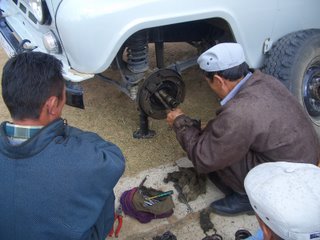
It is mostly pointless for anyone not responsible for driving the car to try to get involved. Such futility usually unfolds thus:

Me: “So what’s the problem?”
Trusty Translator: “He says it’s not a problem.”
Me: “Right.” (pause) “So why is he taking apart the brake?”
TT: (no answer)
Me: “Can you ask him?”
TT: “No.”
Me: “Why not?”
TT: “Because it’s his car.”
Me: “Ah.”

Despite/because of the mechanical know how exerted all over these vehicles, they can be and are fixed with just about anything. When one I was traveling in had its axle mounting come away from the main chassis (thanks to some economizing in the welding department in Ulyanovsk that day), the axle was strapped back on in with wire and string. Okay so it didn’t work for long, but it seemed a plausible repair at the time. When the repair didn’t work, we drove on for 100 kilometres regardless. Uazzerful.

Why else are these cars great? Plenty of reasons. They come in a dazzling array of technicolour hues, including army green, grey, and khaki. You can take out all the seats and turn them into a sleeping space, a dining hall or a ballroom, depending on your needs. There is no upper limit on how many people can fit in them. But most of all, Uazes are great because, like an asylum, they have padded ceilings. While the mod-cons of the rest of the car are no-frills bare minimum tick the box and move on simple, the roof of the car is thickly upholstered like a wingback chair in the gentlemen’s lounge at the country club. There’s no seatbelts, but with a cushioned ceiling you don’t need them- if you hit a bump, you will float through the air, sink comfortably into the ceiling headfirst, and float back to earth like a feather. Your ass is your own responsibility, but Uaz is looking after your head. However, if the ceiling has worn through in places, that may be cause for alarm. Position yourself under a thick bit.

But before you reach for your checkbook and start ordering up a Uaz each for the kids and a brace for the missus, thereby joining a fraternity of motorists whose enthusiasts include the Ethiopian army and the Nepali tourist industry, I fear I must inform you that there is a downside to the Uaz experience. That is to say, a downside if you’ve understood the motoring experience to include an element of comfort. Whoever told you that one has taken unfair advantage of your good nature. For the Uazanite, comfort is as far away as Mongolia is from Montenegro. Seats made of iron planks and rocks, pointy bits of rusty metal just near your tenderer regions, shock absorbers that are adjusted for maximum reverb so you pogo like a punk on every pebble, and ventilation which is either freezing or boiling. Couple that with road surfaces like a bowl of Cheerios, and you’re in for an automotive no-fun ride. For the first few kilometres you can pretend you’re in some kind of music video ride where that lurching up and down is part of the purpose, but an ad hoc imaginary gangsta lean is hardly enough to traverse the steppe with.

Added to the fact that setting off across the steppe usually includes choice between a track off thataway and another off thisaway and the driver can’t decide is the right one, riding the Uaz lightning is an emotional process. In phase one, as you careen from boulder to boulder on the wrong road and have to go back and hit all those same pointless bumps twice, a level of anger, frustration and concern for self rises, wherein you swear that this is positively the last time you’ll rent one of the buckets, and much bile is directed towards all other inhabitants in the car, especially the driver. During this phase, it’s handy not to know any Mongolian, lest one be tempted to verbalize some of these mental stylings.

Then phase two, which begins when Something Happens. Usually this is a breakdown. When temporarily disabled, you have no choice but to look around you and then, the majesty of just where you are sinks in. What’s more, you need that car to get through this, so there’s no point getting pissed at something you cannot hope to alter. Acceptance. When the car gets moving again, phase three begins. Grateful to be back on the road, and with a renewed sense of peace, the landscape takes over, and the sheer wonder of Mongolia’s lands permeates your soul like a warm breeze. As the sun sets and catches the gold in the grass, your aching ass is feeling no pain, but is buoyed along by something bigger. By the time you get where you’re going, all is gentleness and calm. Enlightenment comes on Russian retreads, viewers. Sit back and enjoy the ride.

With inner peace abounding, I will close this entry by saying that after fifty-odd good years, the day of the Uaz is waning. The cheapness of second hand Hyundais has meant that the Uaz is slowly getting squeezed out by the cast offs from Mongolia’s neighbours. While still prevalent outside the capital, the day will certainly come when the Uaz is a relic of a glorious past, along with the hammer and sickle. In the meantime, Mongolia’s drivers do it Russian style, and we here as the Missives salute the spirit of the steppe supped from the goblet of Uaz.
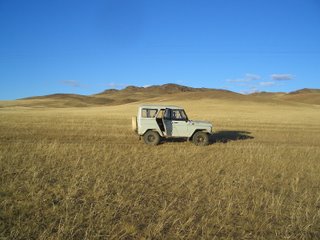
Safe journeys, viewers! (saihan yavaarai!)

(all half-assed research into this article was done from unreliable sources in Ulaanbaatar and the internet. I assume you already figured this out. If you were reading this blog for factual info, then you’re already so off course that you might as well jump overboard and hope that a dolphin carries you home.)

Wednesday, April 19, 2006

Knead to be Needed

Before Seoul Massage


Sonin saihan uu bain, more iin? (What’s new, pussycats?)

If there are any readers left at this point, it must be due to the sheer wonderfulness of intertia, or a certain degree of Pavlovian internet masochism. You are encouraged to cease salivating, for the bell has rung, and after too too long, a new entry is yours for the rumination.

But my oh my modern life viewers. What a tense place it can be, filled with stress and strains, anxieties and pains. And now medical science suggests that such time honoured coping methods as keg stands and Gauloises blondes are actually part of the problem, not part of the solution. Eating your wrinkles away is an option, but how many fudge eating contests can you go to before the fun begins to seep away like so much chocolatey goo? Watching professional sports, picking fights in the street, gambling and psychotherapy all pass the time, but none really reach that deep down fatigue that a body feels at the end of a working week. How to unwind, viewers. How to unwind. The answer is not to try to do it yourself, for you are not a watchmaker with your hands on the springs which make you tick and tock. You need a masseuse. Clearly.

Nestled below us on the first floor of building 37, Chingeltei district, is Seoul Massaj (massage, viewers). During our various travels around southeast Asia, the calming delights of reflexology were explored between noodle dishes and tuk tuk rides, and we acquired a taste for it. Upon our return to the steppe, we decided to sample some of the local fare to see if it compared, and no, it did not. No comparison. It transcended. It was a whole new way of paying someone to beat you up. If southeast Asian massage is a lithe monkey dancing on manicured paws, Mongolian stylee is a mighty great yak with gnarled hooves of power. Bow down in its presence, unworthy ones. One amply proportioned acquaintance of ours described his visit to the ladies of Seoul by saying “a ninety eight pound Mongolian woman took me like it was prison.” A lively description to be sure, but as he’s a human rights lawyer I assume this was a professional assessment of the process.

The foyer of Seoul Massage is a modest affair, no bigger than most department store dressing rooms. A rack of sandals and a matron behind a counter are there, as well as a laminated menu of options. Just as Mongolian restaurants serve both kinds of food (sheep and lamb), Seoul offers both kinds of massage: foot and body (hol and bie, viewers). One price, no fussing. Now get those boots off and get inside. Let’s do a foot massage today, ‘cause these dogs are barking, my verucas are salty, and corns’ coming in by the bushel.

Having removed one’s shoes, you are ushered into the darkened chambers beyond, half of which are equipped with banks of massage tables for those of you who selected the body option (we’ll see you after), and reclining chairs and footstools for the footies. The lighting is discreet and darkened, and a radio burbles out the latest chart nonsense from Asia and the west. Escorted to a recliner, you are presented with your new outfit of striped pajama bottoms and a loose t-shirt (black for boys, orange for girls). While you change from your civvies to your uniform, your captain readies the accoutrements she will require to bend you to her will.

Now as anyone who’s seen Pulp Ficton knows, there are foot massages and then there are foot massages. If Tony Rocky Horror gave Mia Wallace one of what follows, then Marcellus had every reason to suspect that something more than podiatry was going on.

Your massage begins when you sit on a footstool and plunge your feet into a wooden washtub like the ones in old cartoons people used to wear to hide their nakedness. The water is scented with a handful of aromatic herbs to ease relaxation, and is carefully warmed to a temperature somewhere between McDonald’s lawsuit and lava. This tub of water will prove very important for the next little while, as you may frequently need to distract yourself from what else is happening by concentrating on whether your feet have turned to fondue yet. After a few moments to allow your feet to start shriveling down to size three, your masseuse glides into position behind you to begin your foot massage.

Now obviously, a foot massage concentrates on one’s feet. It is thus only logical that this massage starts with your back. As the healing begins, you realize that where southeast Asian masseurs and –seuses spend their days softening their fingers in bowls of jasmine scented oil and drinking mango juice while watching Singapore soaps in air conditioned parlours, their Mongolian counterparts straphang on busted ex-Korean buses to and from a dusty ger where they wrangle with goats and braid rawhide to make ropes to hold the house down when the spring winds hit. These women spend their massage apprenticeship grinding rice into flour in their fists for months before they are allowed near a client. Rumour has it they ran out of rice three winters ago and since then have been using a mixture of gravel and broken glass. By the time you realize how formidable you have been gripped, it is too late and you are no longer holding the keys to the auto of life. These women are small, but they could whup you faster than you could say shiatsu, and that’s just what they’re going to do.

As the pressure exerted on your spine exceeds three atmospheres, another unique element of Seoul massage pokes you in the eye. Hands, which certainly are an important weapon in the available massage arsenal, are only one possible option. Any bit of the body which is bony, pointy, gnarly or strong, can and will be used. And so the moments fly by as you wonder “which bit of you is doing that to me?” Possible answers include elbow, knee, bottom forearm, top of forearm, outer thigh, and foot (it’s a foot massage, remember?). Apparently there is a special treatment which involves steamrolling your body using only the head, but it’s a bit intense.

With your back now living in jelly, it’s time to get on with your foot massage and start agitating your….head. Yep. Can’t just make a beeline for the piggies. Gotta walk the whole course before you race the hounds on it. And so begins a bewildering process somewhere between phrenology and trepanning, whereby your poor old scalp that never hurt a fly becomes the venue for such double fisted techniques as When Elephants fight the Grass is Trampled, Mother Spider Defends her Nest, and sometimes, just sometimes, Joe Pesci’s vice trick from Casino. While all this is happening, in a hopeless effort to escape, you crumple over your knees until you’re hunched like Gollum contemplating your visage in the steaming puddle where your feet now live. In sympathy with your plight, your masseuse starts touseling your hair affectionately, like Dennis the Menace used to get when he’d crash his boxracer into Mr. Wilson’s new mailbox. Whatta scamp. And so, thinking it all nearing conclusion, you begin to extend your neck from beneath your shell. More fool you. What may seem like a friendly touseling between friends is in fact an expert winnowing, whereby weak follicles are being separated from the strong. By the time you realize your predicament, she’s grasped a hold of all the runts straight along your centre part and YANK! She pulls you up to ramrod straight using only ten hairs, Gollum banished forever. Who is in charge has never been more clear. All hail the new queen in town.

By this point, your overheated and puckered feets are quite convinced that they’ve been lied to, and they’re not going to the amusement park after all but are on the way to the doctor’s for a booster shot. They are not wrong. With the back and noggin threats neutralized, our new ruler can finally turn her attention to those neglected..arms. Oh well, at least they’re a limb, so we must be getting closer. At this point the Seoul method becomes slightly clearer- moments of reassuring gentleness are interspersed with sudden, unexpected violence. It’s like how someone once (erroneously) described rolfing as talking about a traumatic experience from your childhood and then having your therapist punch you in the face. It’s sort of like that. Gentle strokes down the bones of each finger, the joints of which are then popped so hard it sounds like timber being felled. But before you have time to muse on this too much more, you are treated to such anatomically impossible feats as the whole arm reverse rotation body pop (whereby your fully extended arm is lulled into such suppleness that your elbow joint is popped upwards), and such symbolic positions as the Figurehead of HMS Victory (fingers knitted behind head, elbows pulled back until almost touching, knee in middle of the back) and the Dying Swan (hands held at wrists, pulled back as far as they go, outer thigh shoving back straight). Another domino of resistance falls, and your entire upper body is now under the flag of Seoul massage.

Your feet breathe a sigh of relief that they have, despite the name of the procedure, escaped with little more than a robust stewing. But your masseuse sees all, hears all. Your feet are finally withdrawn from their solution, and quick as a flash are bound tightly in white napkins lest they try to escape. The washtub is withdrawn, and your reclining chair is stretched out to full flat. Lay your weary and beaten self down on it while she drapes a sheet over you to keep you warm. Since you know what comes after gentleness by now, you instinctively tense up as you assume at least a charley horse or nuggies comes after the comfy blankie. But no, it seems that your feet have finally moved up the queue, and it’s time for them to get manipulated. Surprise and fear are legitimate at this stage. Let them flow, it helps to cleanse.

What happens next is not so much an anticlimax as such a relief that it’s all you can do to stay awake. In keeping with tradition though, your foot is defined as starting at the knee and all points south. You lie under your blanket as your feet are jiggled and your toes are individually fibrillated until you are lulled into a reverie involving mermaids, unicorns and rainbows. After a bit, you realize that for the past five minutes she’s been folding your whole foot over on itself, top over bottom, left over right, like a floppy bit of dough. Whether or not it’s relaxing is no longer of issue, as you lost the ability to form opinions other than ‘owie’ or ‘no owie’ some miles back.

Things are winding up. Your sheets are swaddled up around you like a mummy, and your legs are spun in huge circles over your head like in the halcyon days of breakdancing. Your feet are replaced in roughly the location they started in, and then it’s over.

Like hitting yourself repeatedly with a hammer, the reason to do it is because it feels good when it stops. You are given all the time to convalesce that you need, before you change back out of your scrubs and into your skin. If you are of a hirsute nature, proof of what you have done can be found on your calves, where little snarled clusters of hairy dingleberries have sprouted where your legs were so vigorously kneaded.

As you emerge dazed into the world outside, the sun’s a little brighter, the birds are chirping a little more chirpyily, and the cracks in the pavement seem that much more calm and ordered.

Exhausted but elated, you trudge home a hero, for you have completed your quest and lived to tell the tale. Years from now, your grandchildren will gasp as in wonder as you rhyme them the ballad of the massaged man.

On which mighty note we shall close. I shall end by mentioning that 200 hours of painstaking fieldwork went into researching this article. I hope you realize what lengths I go to on your behalf.

Saihan ahmraraa (have a good rest, viewers),

Jannie

After Seoul Massage