Thursday, February 09, 2006

Mighty Blighty

What Ho, viewers!

February finds us back in Mongolia after a month in the UK, where, if you are reading this, we probably saw you. So hello. If we did not see you in the UK and yet you’re still reading this, why then that is even more remarkable, and you’re the reason we get up in the morning. So why do I feel like rolling over and going back to sleep?

Turning our acute observational eye to Blighty for just a tick, a few small bits and pieces which got lodged in our grill are extracted here for your review. In tribute to our Yorkshire ‘hood’s most glittering literary son Alan Bennett’s annual diary, this entry is in simple point form, easily swallowed and forgotten, like a tuna and sweetcorn on wholemeal.

  • Gastro-notes: As in many other countries, people in the Uke Hey spent a tremendous amount of time going hither and yon in their cars. People are busy, time is money, rush hour must be avoided, the A65’s got roadworks on both sides, but everybody’s gotta eat sometime. Pub meals are expensive and may only be served between precise hours, service areas tend to occur only on main roads and are in any case largely toxic, and the weather may not allow for picnics. All of which combines to create the phenomena of Sandwiches in Cars. In lay-bys, car parks, view points and petrol stations, a quick glance behind the windscreen shows drivers and pax huddled over Tupperware, noshing down two slices with filling. Short rows of three and four cars crouch by the side of the road in murky weather, sometimes supported by a van advertising Hot Food for those not already packing a few rounds. This activity is so ingrained into the fabric of things, and the weather is so insistently uncooperative that people unwind in their spare time by taking their sandwiches for a drive to areas of outstanding natural beauty. You fuel up the motor, tuck your trousers into your socks, put the dog in the back and drive all the way to the Ribblehead Viaduct for a pleasant afternoon among the arches, only to find horizontal rain and a wind with murder on its mind. Typical, isn’t it? Still, seems a shame to come all this way for nothing, doesn’t it? Nevermind, mustn’t grumble. Turn up Radio Four, open up the lunch box, and fog up the car. Everything seems better over a wensleydale and chutney with a smoky bacon crisp. Now where’s the flask? Oooh, luvly.
  • Religious Affairs Department: It is somewhere beyond cliché to complain about the English weather, but even so, it cannot go without mention. On the first afternoon we were there, I took Natty out into the garden at about one in the afternoon. He looked at the sky and the thick grey putty of clouds smeared across it and declared “dark.” No son, that’s what passes for daylight in these parts. From the mouths of babes comes stuff what’s true and that. As if in response to the gloom of winter, the Methodist church in Settle has a poster on its notice board of a sun baked white sandy beach and the surf beyond with the legend “Wish you were here! Love, Jesus” written in ‘handwriting’ font across it. Whether the Son of God is on holiday or works there or something is not clear. Viewers wishing to know more about their spiritual travel options are encouraged to enquire within. And still on the Methodist tip, a Settle lady in the prime of life recently presented one of her ladyfriends with a fresh new copy of the parish newsletter, to which her excited pal was heard to remark “Ooooh! I wish I could reciprocate with the Methodist Recorder!” We assume she was talking about another newsletter, but we could be wrong. if anyone knows if there’s another meaning for “reading the Methodist Recorder”, answers on the back of a postcard of a tropical idyll to our Ulaanbaatar HQ. Best entries will receive a lifetime subscription to Settle Community News. (with a tip of the flat cap to our reporter-at-large T.R-J.)
  • Vice dept: And so on to south London, where the hippest trends are born, and describing someone as “being committed to a decadent lifestyle” is a compliment. Certain parts of south London are less wholesome than others, and are the sort of places where people wear fake rather than real Burberry and say ‘Good Luck’ to their cars before going to bed. But this ramshackle state of affairs of is not a result of incompetent or inefficient local government, social corrosion, dub reggae or the youth of today. Oh no. The seediness of certain boroughs is a result of Drug Tourism. That’s right viewers: it seems that certain neighbourhoods have developed a reputation as being such good places to score that well heeled north Londoners have been known to hop in minicabs and come south with the sole intention of purchasing illegal stimulants and the like, thus bringing otherwise upright areas into disrepute. It is apparently a) impossible to find any illegal product north of the Thames, b) dealers never stray more than three blocks from the building they were born in and c) dealers have no idea how to use courier services, the internet or even those same minicabs that are bringing all them tourists into the once placid boulevards and avenues. And so the drug taking public must journey south. Guerrila action to Take Back the Streets by reversing the trend and sending Brixton residents into Chelsea and Kensington to try to buy there have so far met with inconclusive results. In the meantime, packs of toffs clad in John Smedley curb crawl around Lambeth disturbing the law abiding citizens with their loaded questions about ‘gear’ and ‘could one sort one out’ and the like. Pensioners clutch their pearls to their neck and hurriedly cross the road, remembering the old days when all the houses had bead curtains for doors and you could leave the collection plate in the high street overnight and no one would so much as borrow a farthing. And now? Hordes of Japanese with next-gen cameras and safari jackets clutching the Fodor’s Getting On One in London clog the zebra crossings following tour guides waving antennas with a red rag tied on it as they are led on walking tours of the once reputable shooting galleries and crack dens of SW 11. It’s getting so the streets aren’t safe for the dopeheads anymore. Won’t someone stop the madness? Look, if two Mongolian cops in the only ger in 100 miles can bust timber runners with only their bare hands, then surely the Met can bring the Tourism scourge under control? Our anxious thoughts go out to Mark and Keith, living under siege in Camberwell. Keep hope alive.

On which gritty street-tough note we shall close. Coming soon, more silliness about Mongolia. See you then!

All the best (saihan saihanig husii, viewers),

Jannie

Thursday, January 05, 2006

On Marmots

Shin onii mindh (happy new year, viewers)-
As the mercury plumbs deep new lows, and the lining of one's clothes turns from synthetics to animal fur, winter in Mongolia appears to be among us. On the 21st of December, Mongolians celebrate the beginning of '9 times 9'- the first 33 days represent the start of winter, the next 33 the coldest days, and the final 33 the beginning of the end of winter. While the maths may not add up, and it wasn't exactly above zero before the 21st neither, it is indicative of the fact that outside it's getting a bit froze. It's early 33 days, but thus far it has been within the realm of expectations: don't go outside in shorts expecting warmth and you won't get it- easy! We tip our dogskin boots in sympathy towards our peeps in Minnesota, who suffer the same thing but with less opportunities to eat belly warming meaties than we Mongolian residents have. Nick, fear not: we're saving you a slice of marmot.

Our story this week takes place in the late weeks of autumn, in the soum of Ikh Choloochiheruul, where I had gone with my trusty colleague in a less than trusty rented Russian jeep to inspect the gardening progress of the good people of the soum. This particular spot is two hours flight and five hours drive from Ulaanbaatar, a mere trifle by the standards of the day. By the way, a soum is a Mongolian administrative division roughly equivalent to a county. Each of the 300 soum centres in the country has a post office, a school, a telephone, a bank, a 'hospital', a police station, and a petrol station. Electricity, water, and internet are optional extras.

There can be fewer more futile tasks than assessing a garden plot AFTER the harvest has already been completed- unkind people might suggest it is in fact no different than scrabbling around in a dirt patch, but we food security coordinators are a sharp eyed bunch, and can see things in a pile of dust that the untrained eye would miss. Our mission was compounded somewhat by the fact for this visit we had decided to use the Improvisational Rapid Assessment tool, an old fallback of the humanitarian/development playlist. Basically, you forget to tell anybody you're coming. My colleague Hovdogh had taken care of that step for us, and our local contact had done her bit by shooting off to the capital for a week or two to visit her ailing pop. What, then, to do?

Into this breach stepped the local soum governor, the estimable Tsartsagaan. A lady in the prime of her life, she strode unannounced into our hotel room shortly after sun up. Mongolians, on the whole, don't share western mores about privacy. People in round houses know no corners, or something. Anyway, Tsartsagaan had decided that she herself would escort us to the garden plot, and we could leave forthwith. A woman in a position of administrative power wearing a camel hair twinset and a full head of makeup before nine in the morning is not to be questioned, viewers. Saddle up and ride out.

Driving the fifty kilometres to the project site, the less than trusty driver of our less than trusty jeep whacked in a cassette of the Greatest Mongolian Driving Hits..Ever! His vehicle fully conformed to the basic rules of having a crap car: the more crap the car, the more booming your system must be. So despite this being a car that would later have its front axle mount rupture from the chassis while we were driving, the graphic equalizer and woofer system was presently giving us an immersive aural experience, steppe style. This was then taken to the next level. Due to some mysterious cultural shared consciousness, every Mongolian knows the words to every Mongolian song ever written ever. And every Mongolian must sing, sing, sing. In fact, it is especially important to sing when driving in a car, Tsartsagaan informed me. My pathetic lack of knowledge of Mongolian repertoire was not an excuse, it was a disgrace.

And so with the volume up to eleven, and three throaty companions in good musical spirits, the kilometres flew by like so many miles. Mongolian driving music is a jaunty, exhilarating affair, with lots of cowboy movie strings of the herds galloping majestically across the steppe, uplifting female vocals, and lusty male solo singers, exalting to the great blue skies the greatness of...Their Mums. Yep. Unless specifically stated otherwise, all Mongolian music is a paean to Mater; how she's keeping everyone safe as they travel, how she's just wonderful at making the curds, and how she'll have a warm cup of tea ready for us when we get back. Sung with pep by the cast of Oklahoma, in Mongolian. When I was asked how many western songs are written about mothers, my answer provoked the kind of pitying head shaking usually reserved for stories of puppies left out in the rain.

As the mountain pass gave way to a giant plain, our happy singing car came upon a single dingy ger by the side of the road, incongruously stocked with a huge stack of uncut tree trunks. A quick scan of the horizon confirmed there wasn't a tree in sight, but all was soon revealed. This ger was the temporary shelter for a policeman and an environment officer, cunningly placed to intercept logging thieves and smugglers pinching wood from the forests up north and selling them in the treeless south. Now why treelifters couldn't drive around the only tent in fifteen square kilometers is not clear. Even less clear is why they would even stop for two dudes without so much as two horses between them. It's not many cops who can stop a truck single handed, wrestle the occupants to the ground and arrest them, remove the cargo from the flatbed, do the paperwork and still get a good night's sleep on the cold hard ground at a decent hour, but that seemed to be the m.o. This duo's duties were not limited to busting timberrunners, but in fact covered seizure of all contraband which might somehow be drawn to them. Illegal whatnot of all sorts was winkled out and impounded, as smugglers of all shapes and sizes found themselves drawn, magnetlike, to the only ger in 50 kilometres.

Contraband is like anything else, and is subject to the whims of fashion, trend and taste. In 2005, the number one most wanted illegal item in short supply was the marmot. A big groundhoggy thing that lives in holes, he is marmota sibirica (tarvag, viewers). If you read Russian and can't get enough marmot info, then http://tinyurl.com/7lbee is for you. For the rest of us, it is enough to know that the marmot is a big rat thing that lives in the ground, good for making stoles and other accessories from. Other fun facts about the marmot include that it has fleas that still carry bubonic plague- every year about five or six Mongolians get chomped or mugged by a marmot and get plague. Also, they are congenitally stupid. Like many steppe dwellers there are really, really bored, and spend months inside with nothing to do. So they are easily distracted and will be entertained by almost anything. Over the centuries, the rugged outdoorsmen of Mongolia have worked this out, and lure the marmot from his nest by such cunning predatory manouvres as honking the horn, yelling out "knock knock!", and singing bracing Mongolian hunting songs such as "I kill you good little beastie". Marmots come above ground to see who's throwing the party, hunter shoulders weapon, there is a one sided exchange of bullets, and terminally comatose marmots comes home to daddy.

But the most important thing about the marmot is that while he's an attractive fellow to make a hat from, and a pretty sporting hunt, he is fine, fine eating. Boiled, steamed, grilled or just plain old warmed on the car radiator, he's the rodent of the moment. There are various marmot organs which are considered especially good for one's health, so much so that they are called People Meat (hun mach, viewers). Certain Mongolians are so enamoured of the taste of marmot flesh that autumn just doesn't taste right without a marmoty burp in the gullet. Be that as it may, this year the government decided that a) plague was just really, really medieval and surely we could skip a year without someone coming over all buboed, b) so many marmot munchers had seriously depleted numbers of marmots left in burrows and c) just do what we say. So it was that this year, there was no legal marmot to be had in Mongolia, and lo there was much gnashing of teeth, free of marmoty sinew.

And yet, all hope was not lost for those who'd been looking forward to marmotburger all year. For instance, what of already dead marmot? What if, purely hypothetically, a cop in a ger in the middle of nowhere had intercepted some not alive marmots shot by naughty persons? What if those marmots were more than he could possibly consume I mean enter into evidence himself, even if there was a friend to help him out? What then? Wouldn't it just go bad? Wouldn't that be a crime too? Well wouldn't it? Our hostess in the twinset Tsartsagaan was thinking along the same lines. Plus, as governor, she is the boss of him and does represent the will of the people, so make with the meats, flatfoot.

The finer points of this Socratic dialogue was held in the conditional tense (or at least was translated to me that way), so after a lot of "IF I did have a marmot then I WOULD give it to you" type chortling, it was off to see the soil spot. The project site was a dusty affair, located as it was at the summer grazing spot, now vacated by all but one family. So no people, no turnips, and nothing to assess except the consistency of dust. A successful mission, I'd say.

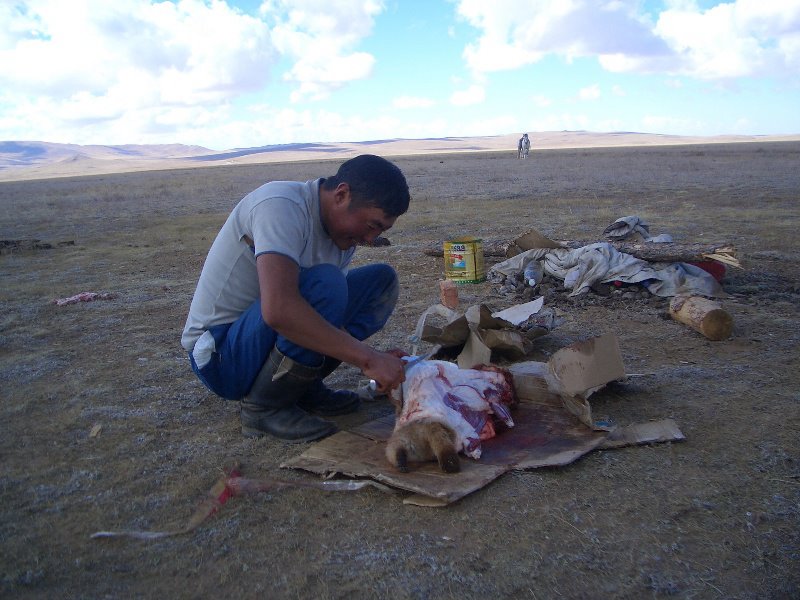
On the way back, we stopped at the same cop ger we'd visited on the way out. By a strange confluence of nature and human appetites, in the hours we were away, not one but two marmots had now been found. One was already in a state of severe undress, in the process of being gutted on a cardboard box. The other? Not totally certain, but Tsartsagaan entered the ger and emerged with a mysterious bundle in her arms covered in cloth, which was then stashed in the back of the car. And back we went to the soum capital to take advantage of the many amenities on offer. Could it be that her parcel of cloth contained a marmot? Who can say with certainty, in today's confusing world? But suspicion points in that direction, viewers. This would not be the only suspicious marmot of an increasingly marmoty trip.

Later that evening, my colleague Hovdogh was greeted by some of her local pals, delighted to see her after such a long absence. To celebrate her return, they had thoughtfully brought her...a marmot. Nicely cooked with not too much salt, presented tastefully squashed into a plastic bag. Hovdogh could not have been happier, she being of the too much marmot is not enough school of gastronomy. Having bought herself a jumbo jar of Polish pickles to accompany her repast, she set to work. Now a word about eating marmot in 2005. You may have somehow found yourself in possession of such a thing, but it is still illegal, and the law is still the law, and you can't just sit on the front step and chow down in full view. One must be discreet. Given that our hosts were mostly government folk of some tier or another, it really wouldn't do to chew on the illicit meat right in their faces- even if they gave it to you. A etiqutte poser, to be sure. The simplest thing to do, really, is chomp it down in the car on one's own. No mess no fuss. Which is what she did. For three consecutive meals, Hovdogh would sit in the passenger seat before we'd go into a house (inevitably for a meal), get out the pickles and paring knife and gnaw away. The standard Mongolian fashion for meat eating is direct under any circumstances, but hunched over a bag of contraband in the car with occasional visible flicks of a greasy knife gave the whole process a certain junkie feel.

Even after three drive-in marmot specials, there was still leftovers, and that same plastic bag was kicking around the car with carcass in it. As we were driving the five hours back to the aimag capital, the driver pulled up on a dried up riverbed and came round to where the marmot bag was. Flipping open a secret panel in the back rear right side door, he stuffed the plastic bag into the leg of a spare pair of trousers and closed the panel again. Why is marmot always stashed inside clothes, anyway? This was apparently necessary because just ahead was another spot where cops and environment officers tended to lie in wait of smugglers, and he didn't want the marmot bag in plain sight. Entertained by the James Bond secret panel (although the similarities ended there), and amused by the fact that in all the great wide open space of Mongolia the cops have an unerring ability to pick their busts in just the right spots, we proceeded towards the suspected trap.

And with all the inevitability of a thing going to happen, there were the cops and environment guys, right on schedule. In fact, not only were they cops and environment guys, they were the SAME cops and environment guys we'd met the day before, accompanied by their superior officer from the capital. Realizing that these dudes has little ground to stand on on the whole 'have you got any illegal marmots in bags in secret panels' type questions seeing as how they were dealers, we were disrespectfully sniggery throughout our questioning. The superior officer saw nothing funny about anything, but other two authority figures shuffled their feet and averted their eyes, waiting for this whole episode to be over. I was later told that if the car was searched, the driver was going to say that the marmot concealing trousers belonged to me, thereby ratcheting up the whole affair to a full blown diplomatic crisis. In the event, all parties agreed it's a rum old world and no mistake, spat in the dust and drove off in search of more marmot related adventures.

The remainder of the trip passed without rodent related incident, although I will close this entry by simply mentioning that under pressure to sample the delights on offer, and on the understanding that you only live once, I was induced to sample a sliver of marmot. Screwing my courage to the sticking post, I did so. I can report without fear of contradiction that it tasted meaty, for the most part.

On which note we shall close- we are away in the UK for the next few weeks, so you'll have to get your jollies at another internet spot till early February, viewers.
Saihan saihuig husii (wish you all the best, viewers),
Jannie

A alleged marmot under interrogation yesterday.

Monday, December 05, 2005

Höi! Lók! Vi got øãr neim inna papir!

Dear Viewers,

While in Thailand, Natty and I were interviewed for the travel supplement of Sweden's leading daily, Aftonbladet. Their reporter on the scene needed our considered views on traversing the globe with kiddies. Our opinions were highly controversial, and fly in the face of much conventional wisdom on such matters. We urge you to take up the debate by clicking on the following link:

http://www.aftonbladet.se/vss/resor/story/0,2789,734903,00.html

If anyone can tell us what in fact we said, we'd love to know. Until then, we will just assume we were witty, insightful and eloquent. Photos of our alluring visages are also thoughtfully included with the article.

Enjøy,

Jannie

Wednesday, November 23, 2005


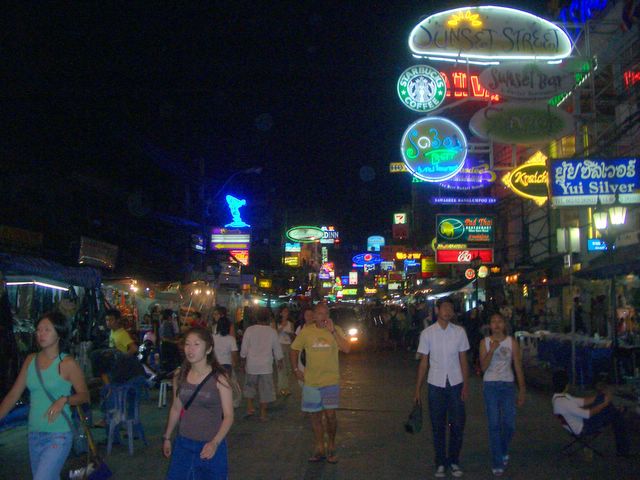
Khao San Road, Bangkok

If it's Monday, this must be Bangkok: A Month in the Southeast Asian Sun

Sawadee, sabadii, and selmat datang (that's hello, hello and welcome in Thai, Laotian, and Malay, viewers)-

In response to requests from some of our more attention deficient viewers who got motion sickness from reading the China dispatch, these entries will be divided into country size chunks, allowing one to come and go as one wishes. We will not, however, be offering TXT message article summaries for those pressed for time. Sorry Jake.

We begin where we began, in Thailand. If you wish to skip to the end and find out whodunnit, bounce down the page to Laos or Malaysia. If you're not too scrupulous about chronology but would like to know what we did recently, start with Malaysia and work backwards. Confused yet? You soon will be.

Thailand- Backpacking, Temperature taking, and the PPC.

The glittering facets of Thailand are generally well documented, and Bangkok is, as it always has been, a dazzlingly fun place to visit. Leaving aside the Golden Temple, the ladyboys selling fried cockroaches, the pleasures of pad thai, and the 4D traffic, Thailand also maintains the element of surprise, as we found out to our credit and debit. So let's balance the books.

Our guest house for this visit was situated within the greater Khao San Road area, home of the one dollar hostel and the globe-on-a-shoestring Shangri-La. The neighborhood streets overflow with travellers from all over the planet in various states of smart/casual disarray, poring over DVDs, grilled squids, cheap luggage, kickboxing lessons and more massage options than a website like this one can explore. It rolls on, 24 hours a day, seven days a week, just as it has for thirty years or more. Purists and those who remember the good old days argue that the Scene has been irrevocably sold out (a vibe explored accurately in Alex Garland's the Beach). Indeed, Khao San Road has become so entrenched that it has itself become a tourist attraction, and now features on the city tour of Bangkok, along with the National Museum and the Democracy monument. More to the point, there's now a Starbucks and a KFC on KS Road, which is of course a sign of apocalypse riding in our midst like so much bird flu in a henhouse.

Despite the taint of commercial spoilage, there are quirks to the KS area which continue to make one smile into one's papaya shake. Travellers of all shapes and sizes use Bangkok as their jumping off point for exploring every place else, so the traffic is considerable. But a time comes in every traveller's voyage when it is time to cast off the livery of the Road, and rejoin the world they came from. Alternatively, living on the cheap is part of the Experience, and with cash in short supply, it may become necessary to pawn that camera/Da Vinci code/pair of hiking boots for bus fare to Singapore. Hence the emergence of the We Buy Everything market stalls dotted along the shady backstreets.

That is what they do: Buy Everything. Hand over your tired Tevas, your clapped out back pack, the flashlight that saved your life in Sarawak, and in exchange get a pittance of baht, or trade it for some other equally second hand bit of kit. Looking at the goods on display at these stalls, one realizes that it is possible to outfit oneself for one's search of self entirely from cast offs from other selfs who went to look for themselves. That sleeping bag may have travelled thousands of kilometres and yet may never leave. And so the backpacker and his Thai hosts have created an entirely self sustaining microeconomy all of its own. No sell out here, greedheads. So please, when next in Bangkok, remember to replenish your water bottle at the Buy Everything well, for it will be returned to you in time.

Moving crosstown somewhat, Natty brought with him from Mongolia a particularly robust cough which required the services of the medical sector, and so we discovered how Bangkok has become a world centre of medical prowess, attracting the infirm and injured from all corners of the globe.
Based on a pointer from a colleague, we headed to the Bumrumgrad medical centre, a gleaming mothership of chrome and green glass built to make you well again. The triage begins in the road leading up to the complex, where uniformed guards peer in the car and point you to the ER, out patient, inpatient, or shopping plaza, and clear traffic for you as befits your condition. When you pull up to the front doors of the place, uniformed bellboys bustle around your car gathering your stuff for you. Next, green suited concierge ladies glide up and politely enquire as to the nature of the ailment, before gently taking your arm and gracefully escorting you to the appropriate bank of elevators. Note the splendid marble atrium and food court on the mezzanine as you go. If English is not your preferred jive, spot a uniformed lady with your national flag on her lapel, and she will translate from Japanese, Urdu, Tagalog or whatever other specials of the day there may be.

Arriving at Kids World (also known as the pediatric outpatient ward), get registered, have a complimentary juice or mineral water, get your new medical credit card thingy, and see one of the bank of doctors on shift. When we were there, the clinic was only half staffed, so there were a mere eight general peds MDs on duty (not counting specialists). If for some bizarre reason you have to wait, then pass the time in the indoor playground, or watching cartoons, or drawing pictures at the crayon table. Racks of the day's newspapers in various languages are on hand for adults. Upon seeing the doctor, who already has your particulars in front of him, get examined, diagnosed, prescribed, get meds, get paid up and get out of there. It took us a whopping fifteen minutes to complete the above, thirty if you count from when we entered the building. We repeated the procedure a few days later, when an x-ray and nebulizer hits were required, and it was equally smooth, the x-ray emailed upstairs in the time it took for us to take the elevator from radiology to Kids World.

Efficacy and medical glitz is all good, but the real draw of medical Bangkok is the cost. For all of the above, consults, x-rays and prescriptions, we paid a total of 160 USD. People from all bits of the world, rich and poor, having expended the available medical options in their neighbourhood, make their way to Thailand. The waiting rooms of the complex were a mushmouth of languages- kids get along with whatever they speak, and adults with not a word in common traded WetOnes, soft toys and held each others kids in an effort to keep everyone happy. So please, when next in Bangkok, remember to have your nose done on the cheap at Bumrumgrad. Today's nose at yesterday's prices. What a wonderful world, folks.

Or rather, it both is and isn't. Our final Thai musings derive not from Bangkok, but from Pattaya, two hours drive southeast on the road to Cambodia. We selected it for our weekend excursion on the basis of its proximity to Bangkok, and the need to see the sea before returning to the steppe. Our expectations of a sleepy seaside town of thatched beach huts, hammocks, and slow boats in gentle clear seas were as fictional as the beach in The Beach. Had we known where we were going, we would probably not have gone. But that, of course, would have been the way of the wuss. And wuss we do not.

Pattaya is a heaving city of two million, most notable for being the epicentre of the seedy, nasty tourism which has long been a mainstay of Thailand’s tourist industry. Given the number of other possible candidates for sleaziest place in Thailand, being the winner is the doobiest of dubious awards.

The town has hundreds of girlie bars, staffed by thousands of bar girls. These establishments are simply ranks of u-shaped bars, lit with the requisite red neon, behind which stand at least one barmaid per barstool, to attend to the client as they enjoy one or more beverages. As language is often (the only thing) not shared between x & y in these transactions, many bars keep a stack of board games on hand, so that the culture gap between can quickly be bridged by a bracing round of Snakes and Ladders. The most popular game by far was Connect Four, by the way. To these bars add dozens more gay/straight/other go-go bars advertising in at least half a dozen languages, market stalls selling key rings and t-shirts with 'amusing' smutty slogans, beersweat and too loud music, and many, many pairings of young Thai women and old, older, oldest white men, and you have a fun filled holiday destination for all the family. As was pointed out to us in Bangkok by a fellow in the know, the advent of Viagra has meant that the age gap between the gent and the lady has broadened considerably. May-December romances are now able to see in the New Year, as it were.

In fact, Pattaya has such allure to some of the world's male population that there is now a significant permanent expatriate population of 200,000 or more, with many more on a quasi-permanent basis. Sun, sand, female companionship, beerhall bonhomie, all in a Benny Hill atmosphere and affordable on a pension to boot: what more could one want? What is most impressive about this enclave is that far from letting their brains turn to mush in this dissolute atmosphere, these émigrés are highly organized. In addition to the requisite club activities, amateur dramatic societies, Rotary and the like, the expats of Pattaya have their own television station, the Pattaya's People's Channel (PPC).

PPC exists to remind the resident farangs of the city that in moving to Pattaya they have made the wisest choice they have ever, ever made. From here on out, it's paradise. The super smiling mzungu presenter and all of his smiling guests share the same evangelical certainty (and blinding teeth- cheap whitening is just one of the many benefits available in Pattaya), and feel the need to convert you, the viewer, to their way of thinking. One interview I saw went a bit like this- two blokes in Hawaiian shirts and cheap linen are smiling at each other on a beach:

Presenter: So how long's it been since you moved here?
Happy Pattaya Farang Resident: Oh, about three years now.
P: And have you EVER been happier?
HPFR: I can honestly say that my life has never been better, and I've never been happier.
P: That's great to hear, that's great to hear. And what were you doing before you came to Pattaya?
HPFR: Brrrr! I don't like to remember it! I was working in [insert profession] in [insert dreary place] when all of a sudden I decided I'd take early retirement and come out there and I here I am and I've never been happier.
P: And will you EVER work again?
P and HPFR together (for this is the funniest joke in the world): Hahahahaha!
HPFR: No fear of that!
P: And you've never been happier?
HPFR: You can say that again! I've never been happier.
P: Really? We get that a lot here at PPC. That's great. You enjoy yourself now.
HPFR: Thanks for that, I will, I will. Many thanks.

Not working ever again is a key component to the Pattaya lifestyle. Following on from the illuminating interview, the next bit of programming was a highlight reel from a recent workshop on the topic of How to Make Money Without Working. Expats in sunwear sat around a hotel conference room and watched a powerpoint presentation on how to make a buck by doing bailiff work, verifying insurance fraud, cockfighting, stunt diving, and many other foolproof schemes, none of which require you to wear a tie or work a nine to five. Unfortunately, I was unable to pick up some of finer points of this process, as the highlights were overdubbed with some happy upbeat music, to remind you how easy and simple it all is- all you need to do is walk away from the rat race and into the arms of Pattaya. What could be simpler?

On that inspirational point, we will bring the Thai chapter to a close. A big wai to you all, and here's hoping that if you end up in Pattaya, you know why you're there.

Taa gaawn,

Jannie

Laos- Slowly, slowly, catchee monkey.


In the wine trade, the personality of a vineyard and the vintages it produces are gauged, inter alia, by soil quality, weather conditions, the grape variety, cultivation and harvest methods, and a final something called terroir. Terrior being the quasi-mystical blend of history, culture, tradition and prestige which allows for a grape grown in the Loire Valley to be inherently more complex than one grown in similar conditions in Mudgee Gulch.

While this may or may not be the case when it comes to wine, the idea of there being an organic, non transferable identity to place is intriguing, and one which fits Lao People's Democratic Republic. Vientiane has terroir, no doubt about it. In a world of Yellowtail Chardonnay, Laos is a Sancerre Sauvignon Blanc.

Laos (or Lao PDR, either way) is sandwiched between Thailand and Vietnam, with China to the north and Cambodia to the south. It's got about six million people, which makes it demographically tiny compared to anywhere except Mongolia, really. It is otherwise tremendously diverse, with 35 different ethnicities spread over its jungly mountains. Laos has 300 varieties of rice, more than any other country except China, yet less than four percent of its land is classified as arable. Economically, Laos languishes way behind Vietnam and Thailand, and seems likely to continue to do so.

The capital Vientiane is a dozy place- hot, humid, and just about to nod off. It has anywhere between 200,000 and 500,000 people, of which no more than about 20 percent seem to be awake at any given time. The head-cleaving heat that bakes the surrounding jungle reigns from 0930 to 1600 makes hats absolutely mandatory, and empties the streets for much of the day of all but the most insomniac residents. Laotian lethargy is legendary- one axiom has it that the Thai grow rice, the Cambodians watch rice grow, and Laotians listen to rice grow. While this makes Laos a somewhat frustrating place to work in for the driven professional, it suits the more relaxed visitor just fine. After the hustle and bustle of metropolitan Ulaan Baatar, it's good to unwind in Vientiane.

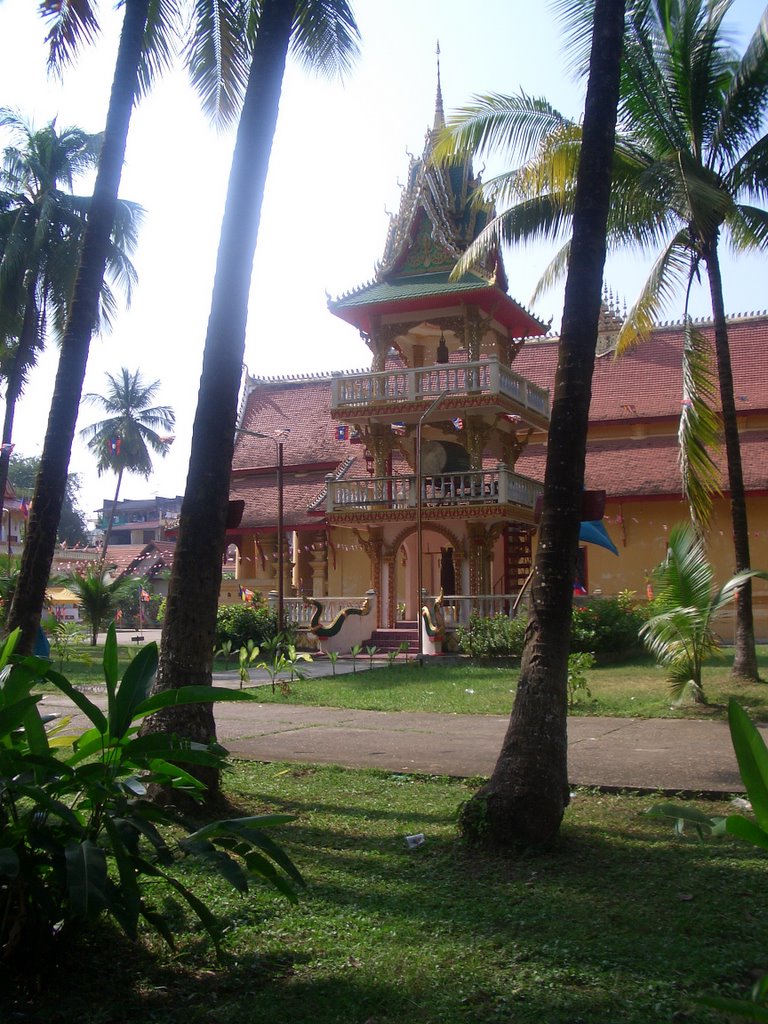
Once the sun moves nearer to the horizon, Vientiane is a lovely place to amble around. Most buildings are no higher than three stories high, and have verandahs on all floors, to cool off the inside of the house when the heat builds up. Laos has significant hardwoods in its jungles, and houses are built of dark, heavy woods carved with flourishes on the eaves, doorways, and grilles. The roads vary between pockmarked tarmac and packed earth. Like other southeast Asian cities, houses are generally open to the street, and market stalls are set up along the streets, selling fruit and veg, coffee and tasty soups and tilapia for lunch. Tuk tuks and mopeds are the dominant mode of transport, which makes for a rush hour that sounds like a dozen sewing machines. People smile, say hello, and walk along gently.

The remnants of Indochine are still in evidence as well. In between the Buddhist temples and government buildings, there are remarkable number of wine shops, one of which has a carved barrel three metres high and two across built about its shopfront. Bistros and restaurants serving French fare abound. Patisseries that bake excellent brioche, croissant and pain au chocolat are on every block. Locals will recommend some establishments for breakfast, some for midmorning, and some are suitable only for lunch, m'sieu. Cafes serving Laotian coffee are in similar abundance- the coffee is, unsurprisingly, marvelous- traditionally served thick and black with condensed milk stirred through it. Laos also remains determinedly francophone, the last remaining holdout in southeast Asia. Street signs are written in Laotian script and French, and people brighten considerably if you parlez-vous. By ten p.m, the streets are just about empty, as everyone has retired to bed after another exhausting day.

All in all, a charming, gentle anachronism of a land stuck between the thrusting economic powerplayers of south east Asia, and a place more friendly than a roomful of handshakes. In a world where the Starbucks on Khao San Road serves the same thing as the Starbucks in Beijing airport or the one in the Borders in Times Square, Kuala Lumpur, Vientiane's cafes continue to serve their own homegrown. And for that alone, we urge you to set sail for the land of the languid.

Ever southwards,

Jannie