Friday, July 15, 2005

(Language x Lessons)2

Just when it was looking like Mongolian was going to stop thrashing around in its cage like some kind of trapped marmot and simmer down and play nicely, it lashed out with another barbed lingual digit, ready to cause a nasty little cut which will no doubt get infected. The other day, as the lesson was winding up, while coming to grips with how to say ‘May I?’, Amagalan and I were discussing whether or not it was possible it was possible to cross Australia by camel- a ruminative cud chewer of a question, to be sure- when I noticed that ‘Australian’ in its Mongolian directive case form (ABCTPaCyrillcLBackwardsN Pyy) came with a small but unmistakable 2 in the top right corner. In effect, Australian was squared- it was to the power of 2. This Australian camel was twice itself. While this might make it doubly cabable in the continent crossing department, it was nonetheless a bit of a poser.

I pointed out this mini-integer to Amagalan, assuming it to be an error. Instead, I was informed that yep, some words in Mongolian can be upped to two
[2]- and in some[3] cases even to four[4]. You see, vowels in Mongolian are either masculine or feminine, and depending on their gender they get either one or the other set of grammatical accoutrements- unless of course they are neutral, in which case they get the neutral set which go with anything, casual or evening wear. However, some words decanted from other languages needs must contain both manly and womanly vowelly virtues, leaving the suffix families with no clear idea where to put themselves. This gender confusion is resolved by the introduction of the Powers that Be, which indicate a word may indeed be one way, but it could also be the other. Lingusitic hermaphrodites. Now tell me, does your language do that? Does it come with inbuilt powerups? It does not. Mongolian is simply more fun that your boring old jibber jabber. Another reason why English is on the way out, kids. Get ahead of the Mongolian wave, for it’s acoming! Get with it, or get out of the way.

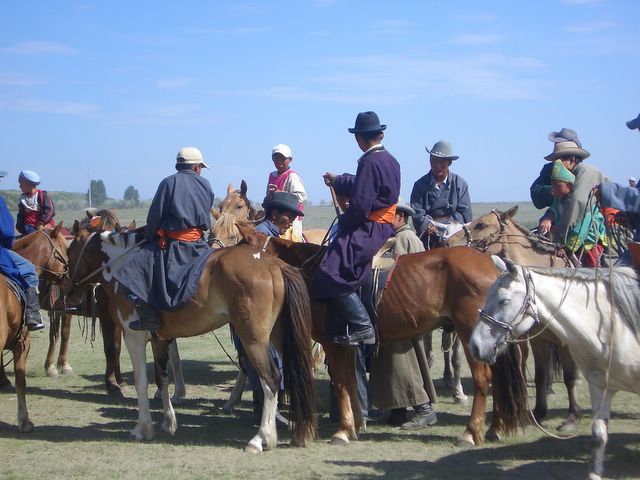
Horsemen and boys review the day's racing at the Naadam festivites in Kharkhorin.

Sunlight, Steppes, and Sandflies

So back we are from our five days in central Mongolia; tanner, wiser, with slightly more telescoped spines than we had before. A definitely worthy and interesting trip to go on- one which ultimately brought home one key fact: this place is huge. No two ways about it. It’s a big ‘un. You could put your keys down in Mongolia and not find them for like, weeks. That song about the bear went over the mountain was definitely composed with Mongolia in mind.
All other attributes of the country are in relation to this biggery. And lest we feel too much like we’re all intrepid and stuff, we covered but a slender morsel of the overall. Four to five hours driving in the country is considered, well, a mild Sunday afternoon’s mosey. And in between what there is to see, there’s more of that great wide open, so really there’s no option but to keep driving. But in the end, it is ultimately that scale which one is seeing. When one can see neither the end nor the sides of the ‘valley’ one is driving along the bottom of, it is easy to wonder about where you are and where you’re going. And to hope that the bloke behind the wheel has a better idea than you do.

Still, all that drive time gives you plenty of time to ruminate, to let the flotsam and jetsam of your mind float freely to the surface, where it bobs around refusing to leave. In my case, hour upon hour was spent with a continuous loop of Celine Dion and Toni Braxton songs in my head (no, I didn’t think so either, but evidently I do) as well as endless repetitions of that Stevie Wonder jazz chord joke (Marcel Grogan, you’re on my list). So time well spent then.

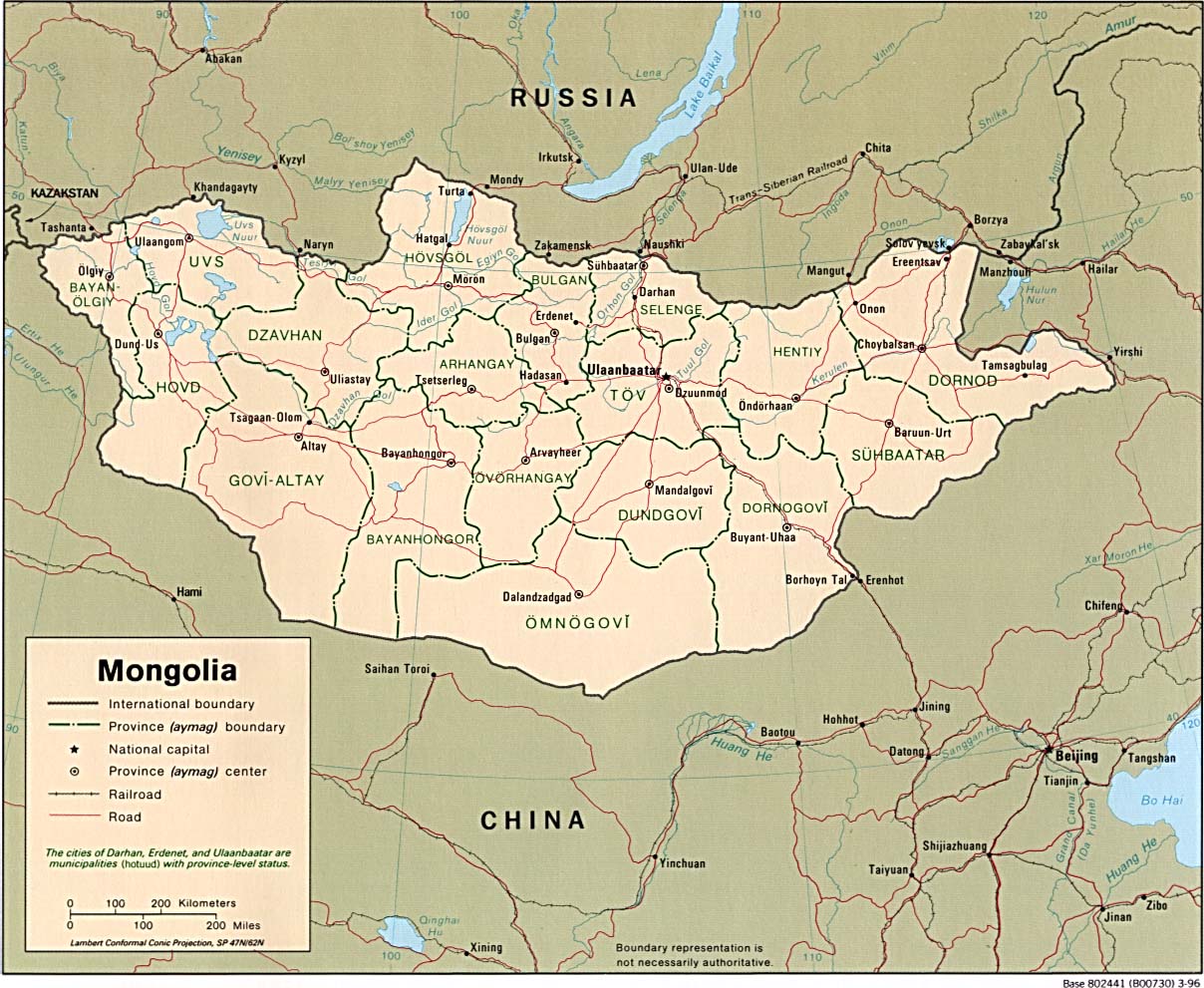
As only few (if any) of you know your Mongolian geography, I’ll keep the itinerary light and frothy, and recommend Tseren Tours for all your Mongolian travel needs. From Ulaanbaatar to Mongol Els, a series of sand dunes far from the Gobi. Then to Kharkhorin, ancient capital of the Mongol empire, and now a dusty little town with a splendid monastery complex. Then to the Orkhon river via Shankh monastery. And from there, back to the capital via the rock formations just east of Mongol Els. All in all, about 700k or so. Tell you what, go look at the pictures in the galleries then come back here.

The trip was punctuated by the requisite punctures, flat batteries, towings and related vehicular japery which come standard as part of any tour in this bit of the world. Having busted the second type and only spare (fun fact: assuming he knows what he’s doing, it takes a grown man 65 minutes to remove a tyre from the rim, reinstall a tube, revalve, and pump up one Mitsubishi Delica tyre, assuming the pump is a one handed Chinese bicycle pump), a runner was dispatched from the capital with a spare in hand, so as not to leave us stranded in Kharkhorin. The driver took off at midnight to meet him at the bus station, but was not back by 0830m the next morning, which led to much hearty speculating. Disappointingly, he did come back, leaving this story generally without incident. Even so- lots of driving is not as tedious as it might be, if only because the sun doesn’t go down until 1030 at night. So even if you arrive in the late afternoon, you’ve still got six hours of daylight to play in, plus it’s not so hot you can’t see straight. Some time thereafter, the sunsets begin- if you haven’t been to the galleries yet, go now.

Despite our desire to be far from the touristic hordes, we were inadvertently ambushed in Kharkhorin. Having secured said tyre, we were on our way out of town when the rumbling in the distance made it clear that Naadam was underway, and the horse were running- and so we visited the local celebrations, which centred on a men, women, boys and girls on horseback circling the ring, whilst within men in open chested singlets wrestled for the greater glory of Mongolia. Around the edge of this hot dusty spectacle, sat the touries, glistening with the healthy pink one sees in the poultry cabinet at the supermarket. Given that there were two more days of this to go and the sun beats down at 40 C plus, it really doesn’t bear imagining what shades of the rainbow were yet to manifest.
Back in the city, the demographic balance of the streets of Ulaan Baatar has, for the course of this two day week, readjusted to be about one foreigner:one local. This is the holiday weekend, so most Mongolians have headed out of the city, whereas most touries are descending. What’s one to do? Heed the call of the wild, and head back to the countryside of course!

And with the weekend beckoning like so many days off at the end of the week, we hope you’ll consider that life is a destination, not a journey, so hurry up and get there already.

Taivan bain (it is peaceful, viewers),

Jannie
Technical Notes: As much as is possible, this blog will not be about blogging, because what could be more boring? But this has come up a few times, so I’m putting it up here for all to know. You can post comments after any article by clicking on the pencil icon, or on the green text with the time signature which appears at the end of each post. You can also read any comments that anyone else has left, and add your two cents if you want to. If you are unable to post for any reason, let me know and I’ll commiserate before offering whatever suggestions I have. Please do feel free to add anything you wish!

Wednesday, July 06, 2005


Flying a kite on the banks of the Tuul river this weekend. Happy Naadam, everyone!

Sporting, Slogans, and Summertime

Ulaanbaatar is all abuzz this week as the countdown to Naadam reaches the T minus 48 hours and counting mark. For those wholly ignirint of all things Mongolian, Naadam is the single most important holiday of the year, stretching from this Saturday through next Wednesday. Among other things, the nine yak tails of Chinggis Khan representing the nine tribes of Mongolia are ceremonially presented to the public in Sukhbaatar Square.
But the big deal is the three manly sporting competitions- wrestling, archery and horseracing events take place at various locations, with much pomp and ceremony throughout. The week is also a chance to catch up on any vodka drinking that you've been putting off for just too long. If you want to learn more about this, I’m sure there’s plenty of ways you could find out- googling on Naadam would be a good place to start, I guess. Seeing as how this is our first year in Mongolia, and given all the excitement simmering in the city as this thing gets closer and closer, we thought we’d do as the locals do and skip it.

As this is one of the, if not the only, big event of the year, the tourists have descended in huge numbers, all ready to film or photograph the six year old jockeys, tubby wrestlers with pointy hats (jainjum malrai, viewers), drinking in celebratory quantities, and yak tails aloft in the breeze. As anywhere, the tourist hordes are much disdained by resident expatties, all of whom either attend small ceremonies at villages outside the capital, or simply take off to the great outdoors and take advantage of the five day weekend to put some serious distance between themselves and the capital. Given how long it takes to drive anywhere in Mongolia, this is not an altogether bad idea.

For some weeks now we were planning to go to Russia by train to visit Lake Baikal over Naadam, but this plan eventually foundered in the shifting sands of Russian visa requirements, which ended up tallying at 250 USD per person- a fee that was too meaty for our palates. Plan B was quickly pulled from the jainjum malrai, and we’ll be exploring the Kharkhorin area of central Mongolia instead. So for those of you who base your week’s activities around updates to this blog (surely someone must), you may experience some delays in the coming days. Try to contain yourselves.

Naadam aside, the musings this week focus on the entertainingly variable application of English in various climes. Fluency is, of course, a state of mind. And frankly, English deserves a few solid punches in the paunch. It walks around the place shouting at the locals and behaving like it owns everything it sees, bullies more polite languages like French, and just keeps getting bigger and more belligerent, ignoring local delicacies and insisting we all sup from the same verbal trough. However, small but determined guerilla movements around the world ensure that nothing is kept OED pure, and pleasing local dishes are concocted from English ingredients. As the world’s lingua franca is twisted back around on itself by those unfamiliar with its ins and outs, the results can be lyrical, baffling, and profound.

Exhibit A is drawn from the streets of the city, as hot temps mean t-shirts and tanks are sported freely. Now one can’t bring the snigger down too hard on this collection- I’m certain that characters from Asian languages are used just as arbitrarily on western clothing- during the heyday of breakdancing (or New Romanticism) when every youth worth his fat sneaker laces (or eyeliner) was wearing something with Japanese or Chinese letters on his head, chest or ankle, I’m sure we went around with spectacular nonsense emblazoned on our bods. Who cares if you’re wearing a headband that says “Sorghum Production Increases following Solid rainy season” as long as you look like the guy from Beat Street? Or a Tshirt which announces “Nissan introduces new management for southern prefectures”? These are but details which are but nothing compared to the value of a powerful fashion statement.

Some clothing in Ulaanbaatar has taken this whole transliterative process to its logical conclusion, and bears messages which simply consist of the garbage that comes from mashing a keyboard- a t-shirt that bears the legend “sdjcvhasjkl;dtujklbh;zsdfajfhasdjklf” makes as much sense as one that says Just do it. Anyway, enough sdfjhkljhjks. Here are a few slogans which have caught the editorial eye of late, all guaranteed 100% not imaginary. All spelling and punctuation as in the original. Viewers are urged to muse on any deeper meanings which may be hidden within these mantras, but are reminded that enlightenment may take years to attain.

- Steady Willingness seems good. To enjoy is a reminisce.
- Pour some sugar me nature
- Only Lyrical Feeling
- Compu Babe what’s Going Happy?
- With the World Together Club Thanks Myself
- Subdued Ten
- Real Clothing Strife Since 1981
- Ivy B Free American College
- Niger (with Nike Swoosh)
- Here Rigo!
- Happy Tree Friends

But all of these aphorisms are but nothing compared to the digital thieves on Pirate street, who dedicate themselves to freeing up needed Hollywood product for the masses. It’s a relatively sophisticated game, and care is taken to make the copy just like the original. However, appearances need only be skin deep, so often the blurb, credits, and cover art are cut and pasted from a variety of sources. Reading the fine print on our copy of About Schmidt yields the information that this film is actually titled ‘Wishmaster 3: Beyond the Gates of hell’. The strapline on the front cover of Forrest Gump trumpets “Good But Flawed”. And consider this verbatim synopsis from the box of Meet the Fockers:

December 19 of local time, remit the with-virtuous- Nero, Barbara- history reach man wave etc. many a film for big wrists <> s(Meet the Fockers) hold the premiere type in Los Angeles, The that slice of is a com edy a <> , Will in day after tomorrow at all and beautiful be shown. The first gathers torelate of is a male nurse to the girlfriend in home to propose but leadA series of farces of the hair, relaxed acquisition in the sil ce’s that year the ticket of USDs 160,000,000Building score, in <>, male nurse with its parents willAc cept the girlfriend a house of” return to visit…

And there it ends. A tantalizing look inside the film, to be sure.

And with these compound fractures of a language that had it coming still fresh, I wish you all happy Naadam, and will update again next week. And I hope we’ll all take a moment to consider that Steady Willingness seems good, and to enjoy is a reminisce.

Sain saihan bukhniig yorooi (wishing you all good things, viewers),

Jannie

Wednesday, June 29, 2005


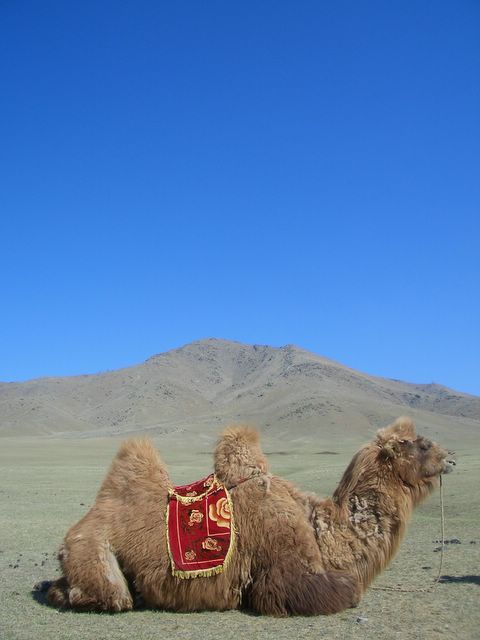
This photo won a local competition in the Fauna category, beating off stiff competition from a lot of photos of horses. The model was not immediately available for comment, but is doubtless ecstatic at this news.

Swimming, Singing and Swabs

Sain bainuu, one and all. Ulaan Baatar is basking in midsummer glow this week- bright sunshine, strong breezes, green trees, and lots of downy seed heads (like dandelions) migrating slowly through the air in great clouds. Grooooovy. Temperatures are well above 30C, and there’s not much in the way of cloud cover, so a thick layer of suncream has become part of the daily regimen. Despite the balminess, yesterday a hailstorm showed up out of nowhere, and turned United Nations Street into a river, so it’s still business as Mongolian usual.

One of our more sharp eyed correspondents who wondered about the heat asked if there are any swimming pools. Thanks for asking, Libby- here’s what’s going on under our bathing cap.

There are a few private pools attached to health clubs, but these are not available to the great unwashed, and inevitably the price of membership is far higher than one is prepared to pay. There is, however, one public pool which is open to all comers. In order to use the facility, one has to undergo a mandatory medical exam on each visit. This practice is not so uncommon, and is likely a holdover from the heady days of socialism- in Serbia, some spas and gyms had a similar practice, whereby a cursory examination (and resultant fee) were occasionally a prerequisite to taking the waters or using the medicine ball.

For the Ulaan Baatar public pool, the exam includes administering an anal swab, to ensure that swimmers are not bringing any worms into the communal pond. Fair enough- no one likes worms. This practice is in place Monday to Friday. Saturdays, however, are free swim, and no medical exam (or swab) is needed. Consequently, this is the busiest day of the swimming week. Mysteriously, despite a rigorous Mon-Fri swabbing schedule, people with clean swabs going in emerge from the water with worms onboard. The medical community is baffled. Can any public health types out there help unravel this wormy problem?

When not swimming in public pools, we’ve been attending concerts at the Academic Theatre of Opera and Ballet, a peach and white coloured building off Sukhbaatar square. The first ticket arrived in Sue’s inbox inviting Ms. S.Southern (and spouse) to an concert of “World Famous Melodies”, commemorating the 10th Anniversary of cooperation between the Government of Mongolia and the Hans Seidel Foundation. Righto. How SS(+s) got on the guest list is anyone’s guess. In fact, who or what the Hans Seidel Foundation is or does is a mystery, even after the concert. It would appear to be some sort of arts patronage body of some sort, but that’s besides the point. They hand out free concert tickets, so that’s what makes them okay in our book.

So up the curtain, and it turns out that the stage is occupied on one side by the theatre’s resident orchestra, and on the other side by the Morin Khuur Orchestra, a traditional Mongolian ensemble, playing horse’s head fiddles and cellos, the zither like things that are played with stick brushes, flutes and piccolos, and more besides which I couldn’t see. The western style orchestra is pretty much per usual, decked out in tuxedos and evening dress, forming a nice visual counterpoint to the white satin traditional Mongolian gowns sat opposite them onstage. The orchestra also had a dedicated triangle player- always a most underrated instrument, and surely the glue that holds the group together. Ding!

On we roll. The programme is an interspersed mix of western (mostly Austrian, which may be a clue as to Hans Seidel’s provenance) and Mongolian pieces. The western stuff is familiar enough that it’s not particularly worth mentioning; Strauss, Mozart, a smattering of Debussy and Saint Saens. The Mongolian pieces, by dint of their unfamiliarity, are perhaps more worthy of comment. The pieces are all titled “The Awakening Spring”, or the “The Quest for the 1000 Nights” and similar such sentiments. The music itself makes for good concert going, especially for the easily bored, largely because it does not use the small brush. More than one piece began with massed timpani, a mighty blast on the horns, all the violins sawing away like crazy, all getting louder and louder until the cymbals go BOOM! Then the real thundering starts. It’s all crescendo and climax, with none of the tinkly bits which lead one’s mind to drift. Spring is Awakening, so eyes up for the big noise. It sounds like one giant herd of horses galloping over the plains. Splendid stuff, all played too loud to allow for sneaky napping. If this sounds like your sort of thing, then check out the works of Natsagiin Jantsannorov, our conductor/composer for the evening, who was awarded the highest honour the state bestows on arty types in the course of the concert, and is now known as the People’s Artist.

Aside from the music and associated whatnot, the show was also noteworthy for being the first classical gig we’ve ever attended where drunk, excitable youth in the audience played a role. While stopping short of shouting “play Cum on Feel the Noize you bastards!”, they did arrive halfway through the show, hang over the dress circle while talking loudly into mobiles and to each other, applaud enthusiastically every possible chance, snuck down into the front row (trailing enough vodka vapour for rows A-F to order a round of mixers), and kicked off the standing ovation at the end of the night. All of which was surprisingly tolerable, because they were behaving like fans, rather than rowdies. A claque with ambition, perhaps. Who knows? Maybe people are just really, really serious about showing their gratitude to foreign arts foundations.

What’s more likely is that audience behaviour is just really, really undisciplined by western concert hall standards. This idea gained credence with the second show of the week, a performance by the world famous Urna at the same theatre a few nights later. Urna, despite being world famous, might not be famous in your world, so here’s a few pointers. Urga Chahar-Tugchi hails from Inner Mongolia, and is renowned as an a cappella singer of tremendous range, who takes traditional pieces of Mongolian music and puts them out into the world. She has a voice which goes all the way up and all the way down, from quiet to loud and back again. She is also something of a fixture on the world music scene, and often gigs with a sitar player and a tabla player. The UB Post (a newspaper which will feature more prominently in later articles) mentioned that she was at some point voted World Musician of the year by the people who vote on these things. So there you are.

Urna maintains a distinctly spiritual pose in her music, both in lyric and emotion- she is very much at one with many things; nature, love, family, peace, gentleness, and so on. If it’s a good thing, Urna’s with it. The following lines were printed on the back of the ticket: “Life. All creatures beautify the world. Touching each other, our hearts are warmed. A tiny candle; its light bright and far reaching enlightening the universe eternally.” What the ticket began, the show meant very much to continue.

This was her first performance to Mongolia, a country she considers “her brotherland” (UB Post), and this was the inaugural show of the Roaring Hooves festival, a two week extravaganza of music across the country. So all in all, a relatively big deal. We went along to hear her (no free tickets this time) along with many other expatties who read the paper and believe the hype. She was accompanied by Zoltan the Hungarian on the violin, who variously strummed, picked, bowed and thumped his violin as Urna sang. Her voice is really rather something to hear; however, her style of delivery is somewhat contingent on rapturous silence, so one can absorb the haunting vibes and delicateness of the voice work. Mongolian audiences do not do rapturous silences very well. Urna’s voice and Zoltan’s violin were beatboxed by various multiple mobile trills, lots of whispering, sweeties and crisps being given an airing, folks arriving late and leaving early, and many more besides. World famous Urna was a bit taken aback by the lack of reverence among her crowd, presumably because this was her first show in the brotherland. She kept appealing for quiet (Hand on chest, eyebrows raised, smiling in disbelief and index finger repeatedly making the shh! gesture), but those calls kept coming in, and more zesty snacks kept coming out of the hamper. To crown it all, the mikes kept feeding back so much that eventually the show had to have an unscheduled intermission for the one techhie to fiddle with wires to make the fuzz go away. All in all, it wasn’t Urna’s night. She’s probably best heard at an outdoor site, in the company of thousands of peaceable WOMAD types who are ready to feel along with Urna. But if you know of another quiet spot, do invite her round to hum a few chords.

And so we’ll leave it there for this time. We hope that you’ve reflected on the fact that whether swimming or listening to ethereal music, it’s always good to have a checkup.

Sain yavaarai (which means safe journey, viewers),

Jannie