Wednesday, November 23, 2005

If it's Monday, this must be Bangkok: A Month in the Southeast Asian Sun

Sawadee, sabadii, and selmat datang (that's hello, hello and welcome in Thai, Laotian, and Malay, viewers)-

In response to requests from some of our more attention deficient viewers who got motion sickness from reading the China dispatch, these entries will be divided into country size chunks, allowing one to come and go as one wishes. We will not, however, be offering TXT message article summaries for those pressed for time. Sorry Jake.

We begin where we began, in Thailand. If you wish to skip to the end and find out whodunnit, bounce down the page to Laos or Malaysia. If you're not too scrupulous about chronology but would like to know what we did recently, start with Malaysia and work backwards. Confused yet? You soon will be.

Thailand- Backpacking, Temperature taking, and the PPC.

The glittering facets of Thailand are generally well documented, and Bangkok is, as it always has been, a dazzlingly fun place to visit. Leaving aside the Golden Temple, the ladyboys selling fried cockroaches, the pleasures of pad thai, and the 4D traffic, Thailand also maintains the element of surprise, as we found out to our credit and debit. So let's balance the books.

Our guest house for this visit was situated within the greater Khao San Road area, home of the one dollar hostel and the globe-on-a-shoestring Shangri-La. The neighborhood streets overflow with travellers from all over the planet in various states of smart/casual disarray, poring over DVDs, grilled squids, cheap luggage, kickboxing lessons and more massage options than a website like this one can explore. It rolls on, 24 hours a day, seven days a week, just as it has for thirty years or more. Purists and those who remember the good old days argue that the Scene has been irrevocably sold out (a vibe explored accurately in Alex Garland's the Beach). Indeed, Khao San Road has become so entrenched that it has itself become a tourist attraction, and now features on the city tour of Bangkok, along with the National Museum and the Democracy monument. More to the point, there's now a Starbucks and a KFC on KS Road, which is of course a sign of apocalypse riding in our midst like so much bird flu in a henhouse.

Despite the taint of commercial spoilage, there are quirks to the KS area which continue to make one smile into one's papaya shake. Travellers of all shapes and sizes use Bangkok as their jumping off point for exploring every place else, so the traffic is considerable. But a time comes in every traveller's voyage when it is time to cast off the livery of the Road, and rejoin the world they came from. Alternatively, living on the cheap is part of the Experience, and with cash in short supply, it may become necessary to pawn that camera/Da Vinci code/pair of hiking boots for bus fare to Singapore. Hence the emergence of the We Buy Everything market stalls dotted along the shady backstreets.

That is what they do: Buy Everything. Hand over your tired Tevas, your clapped out back pack, the flashlight that saved your life in Sarawak, and in exchange get a pittance of baht, or trade it for some other equally second hand bit of kit. Looking at the goods on display at these stalls, one realizes that it is possible to outfit oneself for one's search of self entirely from cast offs from other selfs who went to look for themselves. That sleeping bag may have travelled thousands of kilometres and yet may never leave. And so the backpacker and his Thai hosts have created an entirely self sustaining microeconomy all of its own. No sell out here, greedheads. So please, when next in Bangkok, remember to replenish your water bottle at the Buy Everything well, for it will be returned to you in time.

Moving crosstown somewhat, Natty brought with him from Mongolia a particularly robust cough which required the services of the medical sector, and so we discovered how Bangkok has become a world centre of medical prowess, attracting the infirm and injured from all corners of the globe.
Based on a pointer from a colleague, we headed to the Bumrumgrad medical centre, a gleaming mothership of chrome and green glass built to make you well again. The triage begins in the road leading up to the complex, where uniformed guards peer in the car and point you to the ER, out patient, inpatient, or shopping plaza, and clear traffic for you as befits your condition. When you pull up to the front doors of the place, uniformed bellboys bustle around your car gathering your stuff for you. Next, green suited concierge ladies glide up and politely enquire as to the nature of the ailment, before gently taking your arm and gracefully escorting you to the appropriate bank of elevators. Note the splendid marble atrium and food court on the mezzanine as you go. If English is not your preferred jive, spot a uniformed lady with your national flag on her lapel, and she will translate from Japanese, Urdu, Tagalog or whatever other specials of the day there may be.

Arriving at Kids World (also known as the pediatric outpatient ward), get registered, have a complimentary juice or mineral water, get your new medical credit card thingy, and see one of the bank of doctors on shift. When we were there, the clinic was only half staffed, so there were a mere eight general peds MDs on duty (not counting specialists). If for some bizarre reason you have to wait, then pass the time in the indoor playground, or watching cartoons, or drawing pictures at the crayon table. Racks of the day's newspapers in various languages are on hand for adults. Upon seeing the doctor, who already has your particulars in front of him, get examined, diagnosed, prescribed, get meds, get paid up and get out of there. It took us a whopping fifteen minutes to complete the above, thirty if you count from when we entered the building. We repeated the procedure a few days later, when an x-ray and nebulizer hits were required, and it was equally smooth, the x-ray emailed upstairs in the time it took for us to take the elevator from radiology to Kids World.

Efficacy and medical glitz is all good, but the real draw of medical Bangkok is the cost. For all of the above, consults, x-rays and prescriptions, we paid a total of 160 USD. People from all bits of the world, rich and poor, having expended the available medical options in their neighbourhood, make their way to Thailand. The waiting rooms of the complex were a mushmouth of languages- kids get along with whatever they speak, and adults with not a word in common traded WetOnes, soft toys and held each others kids in an effort to keep everyone happy. So please, when next in Bangkok, remember to have your nose done on the cheap at Bumrumgrad. Today's nose at yesterday's prices. What a wonderful world, folks.

Or rather, it both is and isn't. Our final Thai musings derive not from Bangkok, but from Pattaya, two hours drive southeast on the road to Cambodia. We selected it for our weekend excursion on the basis of its proximity to Bangkok, and the need to see the sea before returning to the steppe. Our expectations of a sleepy seaside town of thatched beach huts, hammocks, and slow boats in gentle clear seas were as fictional as the beach in The Beach. Had we known where we were going, we would probably not have gone. But that, of course, would have been the way of the wuss. And wuss we do not.

Pattaya is a heaving city of two million, most notable for being the epicentre of the seedy, nasty tourism which has long been a mainstay of Thailand’s tourist industry. Given the number of other possible candidates for sleaziest place in Thailand, being the winner is the doobiest of dubious awards.

The town has hundreds of girlie bars, staffed by thousands of bar girls. These establishments are simply ranks of u-shaped bars, lit with the requisite red neon, behind which stand at least one barmaid per barstool, to attend to the client as they enjoy one or more beverages. As language is often (the only thing) not shared between x & y in these transactions, many bars keep a stack of board games on hand, so that the culture gap between can quickly be bridged by a bracing round of Snakes and Ladders. The most popular game by far was Connect Four, by the way. To these bars add dozens more gay/straight/other go-go bars advertising in at least half a dozen languages, market stalls selling key rings and t-shirts with 'amusing' smutty slogans, beersweat and too loud music, and many, many pairings of young Thai women and old, older, oldest white men, and you have a fun filled holiday destination for all the family. As was pointed out to us in Bangkok by a fellow in the know, the advent of Viagra has meant that the age gap between the gent and the lady has broadened considerably. May-December romances are now able to see in the New Year, as it were.

In fact, Pattaya has such allure to some of the world's male population that there is now a significant permanent expatriate population of 200,000 or more, with many more on a quasi-permanent basis. Sun, sand, female companionship, beerhall bonhomie, all in a Benny Hill atmosphere and affordable on a pension to boot: what more could one want? What is most impressive about this enclave is that far from letting their brains turn to mush in this dissolute atmosphere, these émigrés are highly organized. In addition to the requisite club activities, amateur dramatic societies, Rotary and the like, the expats of Pattaya have their own television station, the Pattaya's People's Channel (PPC).

PPC exists to remind the resident farangs of the city that in moving to Pattaya they have made the wisest choice they have ever, ever made. From here on out, it's paradise. The super smiling mzungu presenter and all of his smiling guests share the same evangelical certainty (and blinding teeth- cheap whitening is just one of the many benefits available in Pattaya), and feel the need to convert you, the viewer, to their way of thinking. One interview I saw went a bit like this- two blokes in Hawaiian shirts and cheap linen are smiling at each other on a beach:

Presenter: So how long's it been since you moved here?
Happy Pattaya Farang Resident: Oh, about three years now.
P: And have you EVER been happier?
HPFR: I can honestly say that my life has never been better, and I've never been happier.
P: That's great to hear, that's great to hear. And what were you doing before you came to Pattaya?
HPFR: Brrrr! I don't like to remember it! I was working in [insert profession] in [insert dreary place] when all of a sudden I decided I'd take early retirement and come out there and I here I am and I've never been happier.
P: And will you EVER work again?
P and HPFR together (for this is the funniest joke in the world): Hahahahaha!
HPFR: No fear of that!
P: And you've never been happier?
HPFR: You can say that again! I've never been happier.
P: Really? We get that a lot here at PPC. That's great. You enjoy yourself now.
HPFR: Thanks for that, I will, I will. Many thanks.

Not working ever again is a key component to the Pattaya lifestyle. Following on from the illuminating interview, the next bit of programming was a highlight reel from a recent workshop on the topic of How to Make Money Without Working. Expats in sunwear sat around a hotel conference room and watched a powerpoint presentation on how to make a buck by doing bailiff work, verifying insurance fraud, cockfighting, stunt diving, and many other foolproof schemes, none of which require you to wear a tie or work a nine to five. Unfortunately, I was unable to pick up some of finer points of this process, as the highlights were overdubbed with some happy upbeat music, to remind you how easy and simple it all is- all you need to do is walk away from the rat race and into the arms of Pattaya. What could be simpler?

On that inspirational point, we will bring the Thai chapter to a close. A big wai to you all, and here's hoping that if you end up in Pattaya, you know why you're there.

Taa gaawn,

Jannie

Laos- Slowly, slowly, catchee monkey.


In the wine trade, the personality of a vineyard and the vintages it produces are gauged, inter alia, by soil quality, weather conditions, the grape variety, cultivation and harvest methods, and a final something called terroir. Terrior being the quasi-mystical blend of history, culture, tradition and prestige which allows for a grape grown in the Loire Valley to be inherently more complex than one grown in similar conditions in Mudgee Gulch.

While this may or may not be the case when it comes to wine, the idea of there being an organic, non transferable identity to place is intriguing, and one which fits Lao People's Democratic Republic. Vientiane has terroir, no doubt about it. In a world of Yellowtail Chardonnay, Laos is a Sancerre Sauvignon Blanc.

Laos (or Lao PDR, either way) is sandwiched between Thailand and Vietnam, with China to the north and Cambodia to the south. It's got about six million people, which makes it demographically tiny compared to anywhere except Mongolia, really. It is otherwise tremendously diverse, with 35 different ethnicities spread over its jungly mountains. Laos has 300 varieties of rice, more than any other country except China, yet less than four percent of its land is classified as arable. Economically, Laos languishes way behind Vietnam and Thailand, and seems likely to continue to do so.

The capital Vientiane is a dozy place- hot, humid, and just about to nod off. It has anywhere between 200,000 and 500,000 people, of which no more than about 20 percent seem to be awake at any given time. The head-cleaving heat that bakes the surrounding jungle reigns from 0930 to 1600 makes hats absolutely mandatory, and empties the streets for much of the day of all but the most insomniac residents. Laotian lethargy is legendary- one axiom has it that the Thai grow rice, the Cambodians watch rice grow, and Laotians listen to rice grow. While this makes Laos a somewhat frustrating place to work in for the driven professional, it suits the more relaxed visitor just fine. After the hustle and bustle of metropolitan Ulaan Baatar, it's good to unwind in Vientiane.

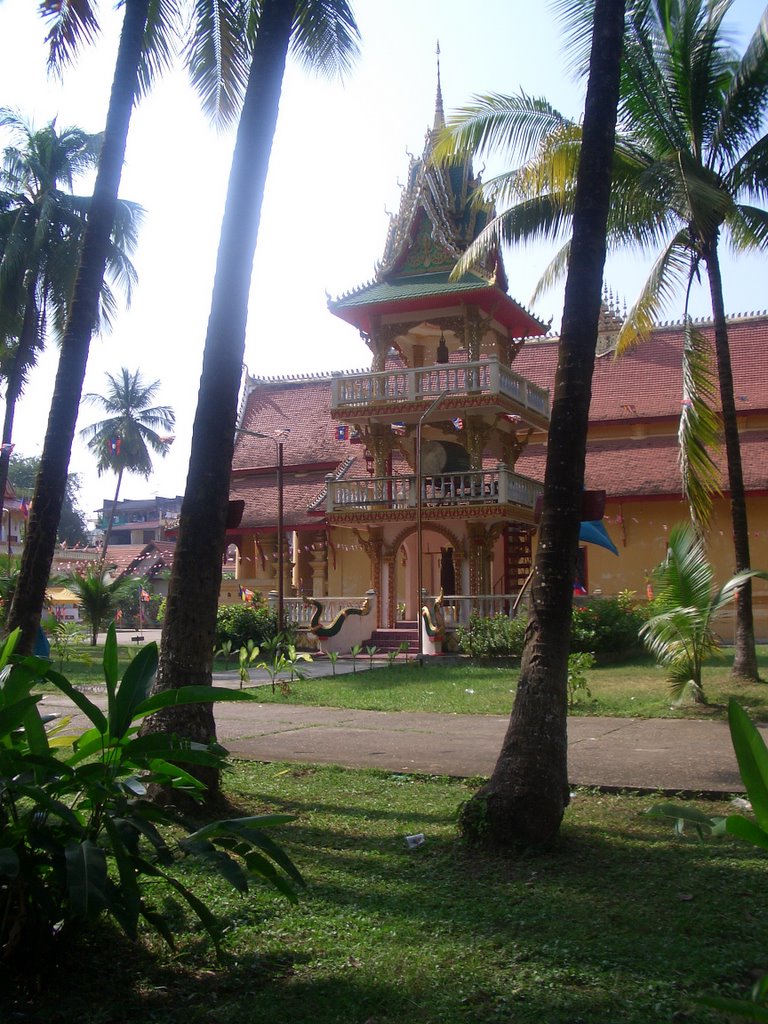
Once the sun moves nearer to the horizon, Vientiane is a lovely place to amble around. Most buildings are no higher than three stories high, and have verandahs on all floors, to cool off the inside of the house when the heat builds up. Laos has significant hardwoods in its jungles, and houses are built of dark, heavy woods carved with flourishes on the eaves, doorways, and grilles. The roads vary between pockmarked tarmac and packed earth. Like other southeast Asian cities, houses are generally open to the street, and market stalls are set up along the streets, selling fruit and veg, coffee and tasty soups and tilapia for lunch. Tuk tuks and mopeds are the dominant mode of transport, which makes for a rush hour that sounds like a dozen sewing machines. People smile, say hello, and walk along gently.

The remnants of Indochine are still in evidence as well. In between the Buddhist temples and government buildings, there are remarkable number of wine shops, one of which has a carved barrel three metres high and two across built about its shopfront. Bistros and restaurants serving French fare abound. Patisseries that bake excellent brioche, croissant and pain au chocolat are on every block. Locals will recommend some establishments for breakfast, some for midmorning, and some are suitable only for lunch, m'sieu. Cafes serving Laotian coffee are in similar abundance- the coffee is, unsurprisingly, marvelous- traditionally served thick and black with condensed milk stirred through it. Laos also remains determinedly francophone, the last remaining holdout in southeast Asia. Street signs are written in Laotian script and French, and people brighten considerably if you parlez-vous. By ten p.m, the streets are just about empty, as everyone has retired to bed after another exhausting day.

All in all, a charming, gentle anachronism of a land stuck between the thrusting economic powerplayers of south east Asia, and a place more friendly than a roomful of handshakes. In a world where the Starbucks on Khao San Road serves the same thing as the Starbucks in Beijing airport or the one in the Borders in Times Square, Kuala Lumpur, Vientiane's cafes continue to serve their own homegrown. And for that alone, we urge you to set sail for the land of the languid.

Ever southwards,

Jannie

Malaysia- Malls, Monorails and Money

As Lyle Lanley told the citizens of Springfield, "You know a town with money is a little like the mule with a spinning wheel. No-one knows how he got it and danged if he knows how to use it!"

Lanley's sold monorails to the towns of Ogdenville and North Haverbrook, which really put them on the map. What he neglected to say that he'd also sold a monorail to Muddy Confluence, Malaysia. So as soon as we saw a monorail in Muddy Confluence, we knew we were in for comedy fun. We were wrong, but Lanley was right.

Muddy Confluence sure has money- they've got oil, electronics, Formula One Racing, and Michael Bolton playing at the Genting Highlands resort in November. MC also shares with Springfield a real desire to get noticed by the world- they've got the world's second tallest building (stupid Taiwan), the world's fifth highest communications tower (stupid China, Canada, Russia and Iran), the world's longest apple strudel (80metres), and the world's largest replica camel collection (200). Reports that they will challenge Springfield for the largest pile of burning tyres remain unconfirmed.

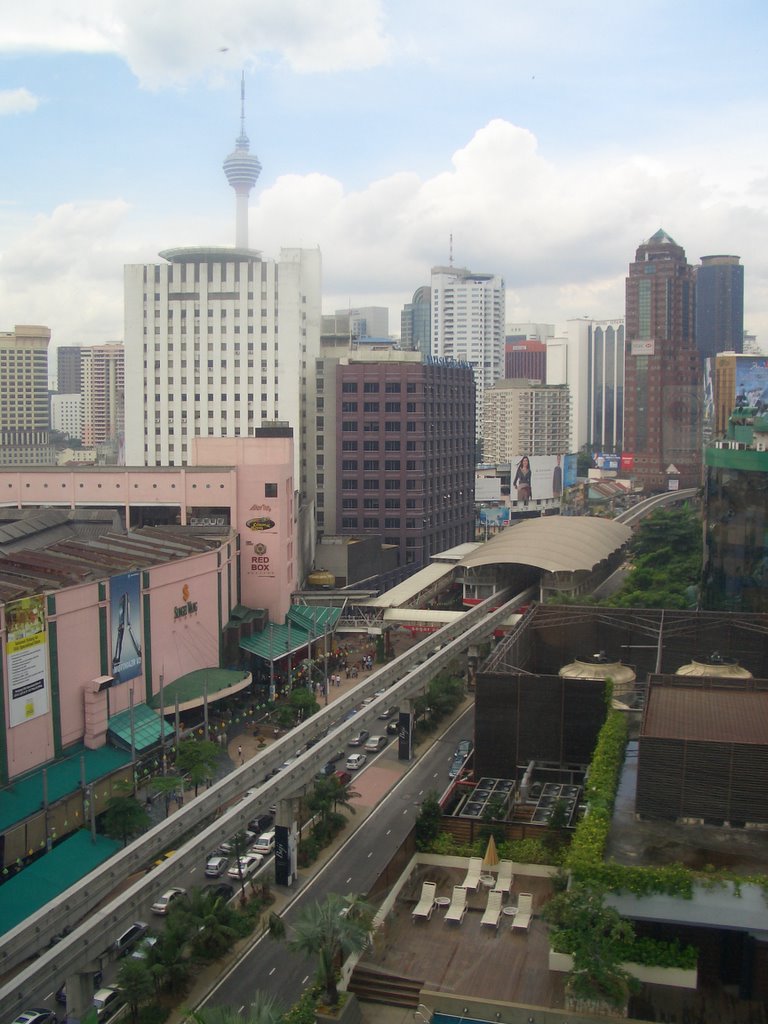
But it's not all records and monorails in Kuala Lumpur, which is the Malay name of Muddy Confluence. For all its money, Kuala Lumpur has about as much idea what to do with it as that mule mentioned above. Put another way, Malaysia knows EXACTLY what to do with all that money, and that’s spending it on huge construction projects which will shine brighter and better than any before. Add that to the fact that the Malaysian national pastime is shopping, and you have a recipe for more malls than the eye can see. Malaysia claims to have the world's largest mall, and this is all too plausible. The Times Square complex has eleven stories, including an indoor amusement park and an IMAX theatre. Suria KLCC is embedded into the feet of the Petronas Towers, and has six stories of shopping and an aquarium. There are many more.

Not unlike Beijing, Kuala Lumpur is strongly focused on making and spending of cashmoney. Unlike Beijing, the process of turning the place into one big shopping centre is so far completed that it is wholly possible to lose all sense of where you are- you are standing outside the Debenham's and might have a snack at Baskin Robbins or Famous Amos on your way to Marks & Spencer. Welcome to AnyMall, Planet Earth. Buy buy buy. The whole consumerist experience has been hermetically designed that no unpleasant indigenous variations seep in; in some cases quite literally, as malls have no windows to the outside world and are air conditioned to sub-arctic temperatures. Walk by a mall entrance at ten yards, and a blast of cold air hits you sideways, as Malaysia attempts to cool down the tropics from the inside out.

This nonstop shopping might has some explanation if prices were anything to shout about, if bargains might be had. But no, the similarity between western malls does not end with the choice of shopping outlets; the prices are comparable as well. Despite this, and despite the presence of cheaper prices in Bangkok and rock bottom prices in Beijing, Kuala Lumpur overflows with Aussies, Kiwis and Brits on shopping holidays, whatever circle of hell that may be. You can buy city maps which chart the smoothest passage from one mall to the next, without having to tread in any culture by mistake. Some of the monorail stops disgorge passengers directly into malls, without having to touch the street.
The tourists are far outnumbered by locals in the throng. Sporting the slickest phones, bluetooth headgear, watches, flashdrive accessories and sunglasses, the aspirational model of today's Malaysian youth seems entirely western, derived from mass media arbiters of cool, and forms a homogenous uniform appearance, in lockstep with their US and UK contemporaries. They behave just as badly, and sad to say, are just as fat. Kids today, viewers. I tell you.

None of this is to begrudge Malaysia any of the success it apparently enjoys. But surely there is a more useful way to spend all of this money in a way which does not simply add more malls to the world? Everyone has the right to shop in the same places, I suppose. Is shopping a human right? Discuss. On the other hand, making the whole thing so indistinguishable from its western counterparts that walking into such places is an empty, eviscerating experience isn't a good thing either. Presumably, there will one day a reckoning, as people realize that there's more to life than Sunglass Hut and Accessorize, and new money will no longer be poured into building more and more caves of shopping. Until that day, we have the KL experience.

Kuala Lumpur's residents are serious about making it in today's capitalist world, and are prepared to work very hard to do so. The business pages of the Straits Times takes up at least half the daily paper. The front displays of any bookstore are filled with management handbooks with titles like How to Make Your First Million, and Secrets of Microsoft: The Bill Gates Approach to Management. The payoff to all this is that Malaysia has tremendous human capital, and is a major Asian economic contender.

One suspects that this highly organized business approach is congruent to that of Singapore, Malaysia's neighbour to the south, and member of the federation of Malaysia until 1965. Like Singapore, Kuala Lumpur is very clean and very well organized, and its citizens generally are well behaved and law abiding. Ambition is obviously much valued by the Malaysians, both in terms of the individual pursuit of success, and in demonstrating to the world just how much Malaysia can accomplish if it sets its mind to it. Petronas Towers is perhaps the most obvious example, and features as the icon of the country on the currency, in advertising, and as the logo for the ASEAN conference scheduled for December 05. Globally speaking, Malaysia is fully expecting to join the 'G-9' in 2020. The government is nearing completion of a private city from which to conduct its business, the ten billion dollar Xanadu called Putrajaya, which comes replete with ministries, offices and residences for the Prime Minister and the King, a vast pink mosque and a stocked artificial lake for the PM and the Cabinet to commute up and down in special boats. Oh, and an air conditioned shopping plaza, naturally. Putrajaya is adjacent to the high tech exclusive suburb of Cyberjaya, which has wifi internet access from every toilet and breakfast hutch.

So far, so sterile. Rabid shopping, white elephant architecture, too much air conditioning, and high prices. Add to that the sin taxes the government exacts on beer (four bucks for a bottle of Tiger), and Malaysia is shaping up to be the fishbone in the trachea of south east Asia.

And yet.

Scratch the surface even a little bit, and Malaysia is a fascinating country. This is perhaps what is so frustrating about the whole way that Kuala Lumpur has been developed, is that it does the complexity of Malaysian society such a disservice. First off, Malaysia is an ethnic and cultural hybrid comprised of its own indigenous elements with strong inputs from China and the Indian subcontinent. Fifty odd percent of the population is Malay, twenty five percent Chinese, and the remainder are of various south Asian origins, plus others from Malaysian Borneo and farther afield. While avowedly a Muslim state, Malaysia nonetheless has significant Hindu and Buddhist populations, as well as Christians and animists, and maintains a climate of considerable freedom of worship.

Over the centuries, Malaysia has developed a cultural absorptive capacity that allows it to incorporate significant populations from China and India without having its own identity overwhelmed. Granted, this has not always been a flawless process, but it has unfolded comparatively bloodlessly, and diversity is strongly valued by Malaysians. Our visit coincided with Aidalfitri and Deepavalii, and the town overflowed with public celebrations of all kinds to celebrate the culmination of the Muslim and Hindu holy days. Over the decades since independence, there have been consistent dark mutterings that the Malaysian socio-cultural equation is too delicately balanced, and could collapse into chaos at any point as a result of independence, communism, Indonesian influence, Malay-Chinese desire for dominance, extremist Islam, and so on. Nevertheless, Malaysia has held firm, and shows no signs of splintering into its base components, if indeed anyone could reverse the process.

This ethnic diversity is so interwoven that it is impossible to determine at a glance whether someone is Malaysian or not based on physical appearance. Like riding a train in New York or London, riding the monorail in Kuala Lumpur it is impossible to determine who is local and who is visiting. Waiting for the ferry in Port Klang, two chaps who looked Tamil sat down with another two guys who could have stepped off the streets of Beijing and their pal who could have been (maybe was) Filipino. The five of them have a coffee and smoke (everyone smokes in Malaysia), jabbered away in one language, answered their mobiles in English, switched to another language, back to the first language, and all carried on. On Pelau Ketam island, the same variety of appearance continued, but all the signage was written in Chinese, although everyone spoke English. Muslim teenage schoolgirls wear tight jeans and tiny tops, but with a tundung headscarf over their heads. I saw one such outfit in which the tundung was pinned at the shoulder with a smiley face button. Business as Malaysian usual.

This plurality of influence and heritage is also deliciously evident that in the available eating options in KL. Indian buffet restaurants specializing in tandoor stand right next to (or share tables with) stalls specializing in Penang prawn fried noodles, which in turn are next a place doing grilled chicken fish with ginger and soy sauce. Single meals consist of great dishes from all over the place, and ingredients are borrowed and then lent back across the various cuisines. Even against the greatness of Thai or Beijing foodie options, Malaysia has such extraordinary variety of choice that eating well is well and truly one of the prime attractions of Kuala Lumpur.

Malaysia is not, per se, a global Great Culture, in the way that China or the United States exude influence across the world. Not that this is necessarily a bad thing. Malaysia seems rather to be able to take up what is on offer from other cultures, and fold it into its own mix. While the wholesale inhalation of consumer culture leads to the homogeneity of the malls, it also allows for the people who shop in them to be part of a dynamic and vibrant multiculture. That's why it's such a disappointment to see the youth getting cloned to look like every other teen on the planet. Kids today, viewers.

All is not forever rosy in the land, and there is a darker side to the Malaysian profile. The ruthless drive to succeed takes place within an autocratic state that regularly represses 'unfavourable' elements, especially southern Islamic political parties, a catspaw media, and is dependent on exploited migrant labour. A rigid social hierarchy, enshrined in the constitution, ensures that everyone knows their place. Within the Indian population, inherited caste systems from the subcontinent delineate just who's who and why they'll stay that way. Populations in Borneo are significantly less attended to that those on the Peninsula. In addition to the cast off migrant labourers adrift in Malaysia, refugees from Thailand, Burma and the Philippines waft in and out with regularity.

For all the carefully planted parks and manicured architecture, real life is far more interesting in Malaysia than it lets on. Far removed from the gleaming marble of the mall floors, there's a whole country out there waiting to be tasted, walked in and discussed. So next time you're there, please remember to ride the monorail to the end of the line, and start walking from there.

On which impractical advice we shall close. If you've read this far, you probably deserve a southeast Asian holiday all of your own.

No further travel is slated anytime soon, so relax in the knowledge that the next dispatch will be back on the freezing solid ground of Mongolia.

Selamat jalan,

Jannie

Wednesday, November 16, 2005


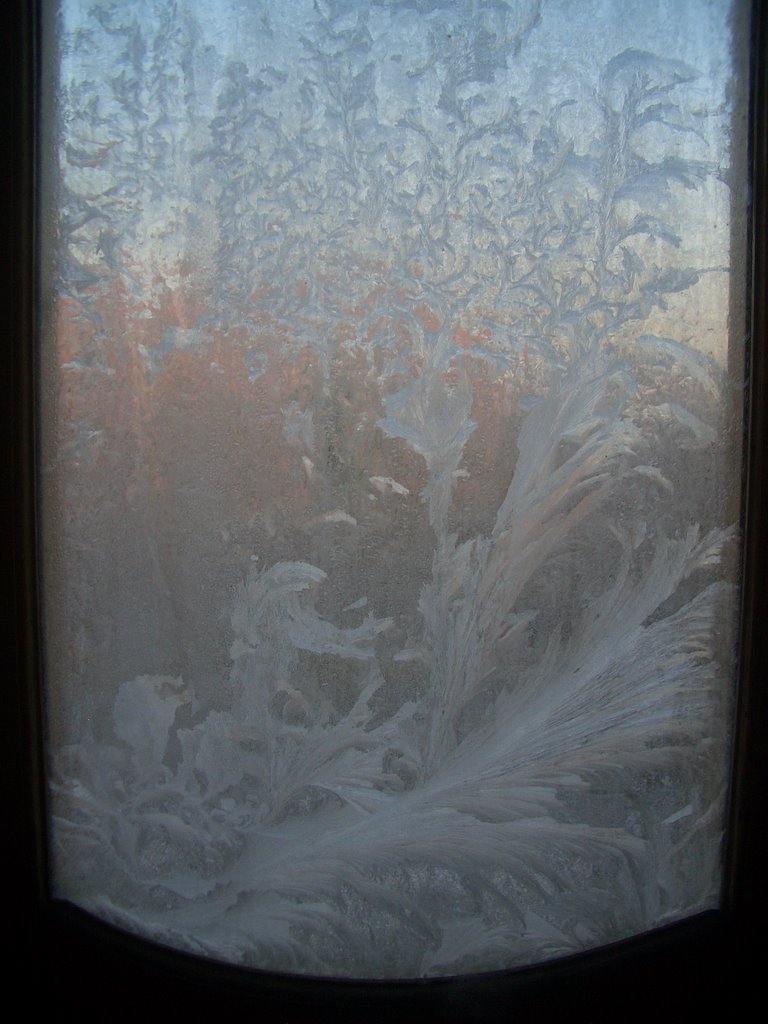
Frost forms on our bedroom window this morning.

Friday, October 07, 2005


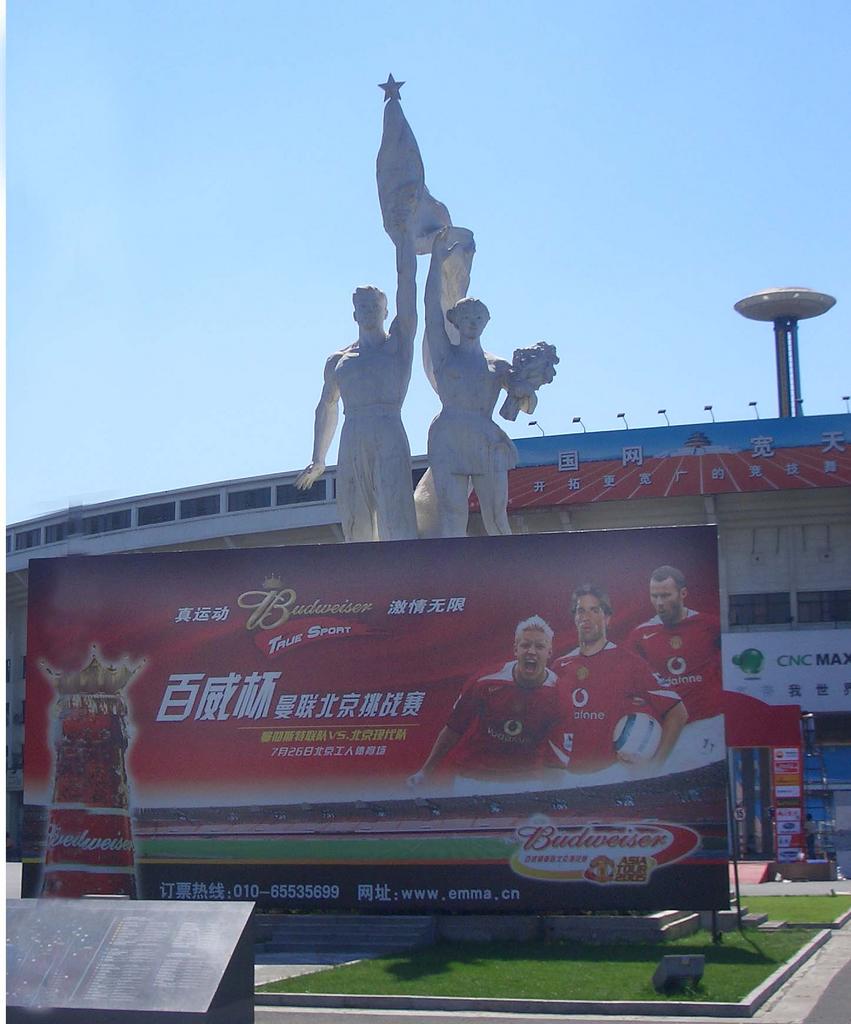
The glorious sportsmen and women of the revolution vs. the marketing might of Manchester United. Worker's stadium, Beijing.

Beijing Babylon


Mihaa! (Greetings, viewers, but not in Mongolian.)

I've been struggling with this piece for sometime now, and have eventually had to release it into the wild without having given it a full physical. Even so, despite wrestling with the subject matter, I have not been either shooting arrows at it or horse racing it, for this is not a Mongolian issue. This piece concerns China. China, on the other hand, is probably deeply unconcerned by this piece. Quid no quo. Grab your wontons and green tea and settle in.

China is, as we know, intrinsically vast. Any discussions of China presupposes this massive girth- geographic, demographic, economic, cultural, historical, take your pick; it's a behemoth. There's no such thing as a little China.

Playing the numbers with China is a mug's game, because the figures involved are akin to those used to calculate distances in space, but it may be instructive to mention a few here. 1.3 billion people (that's 20 percent of everybody), spread over 9.6 million square kilometres. Shared borders with 14 other countries. A total of 1.8 million kilometres of roads, with five million private cars purchased a year. Annual growth rates in double figures, despite unemployment rates of 20 percent. The second largest economy in the world, ranked 85th on the Human Development Index. Three hundred million people without adequate sanitation. Whatever point it is one is trying to prove, the numbers for China will make the point for you dramatically.

But what, then, is the point? How to encapsulate all that bigness into one easily digestible intellectual biscuit? Bearing in mind the fallacy of the visitor in any circumstance is to try to extrapolate a grand theory based on a set of thin conclusions, conclusions which are in turn a result of a narrow set of experiences comprised of a fistful of rapid observations. So we're still no closer.

This extemporizing is problematic when considering Lichtenstein or Tonga, but applying this approach to China is unwise indeed. The plurality of the Chinese whole defies comfy theorizing- any operant assumptions are easily contradicted just around the next corner. Much of what one hears or assumes about China is wrong, or at best readily deniable. This isn't particularly unique- the same applies to much of what is written and said about America. Nonetheless, that doesn't stop anyone from coming up with pat assumptions and one sentence summaries.

All of which is to say, much of what follows is wrong.

Through the centuries, China has kept going, come what may. At massive cost and with sometimes retrograde motion, but it is as it has been for thousands of years: immensely powerful. China in this regard contravenes the standard narrative applied to dominion- implicitly, the notion of empire presupposes decline and fall. Rome, the Mongols, The Ottomans, the British, the Soviets-their empires have come and gone, while geopolitically speaking, the Chinese are still in the hunt, and could still ascend further. This is perhaps due to the fact that China's mass is contiguous, and consequently easier to control than a far flung series of satelites might be. This is painting in broad strokes to be sure, but the fact is that the future of a strong China is still playing out, and does not represent a closed historical chapter in the same way that say, the British Empire does. China has declined and fallen flat any number of times- a fair few times in the 20th Century alone- but with every seeming collapse China reinvents itself and carries on, apparently gaining momentum as it does so. Formidable ironies pile up quickly, as yesterday's anathema is today's ordre du jour, but perhaps it is this mutability which keeps China's sails so full of wind.

The result of this ideological pig pile is juxtaposition of everything one might care to ascribe to the concept of China, writ on a massive scale.

As one approaches the sleepy little hamlet of Beijing (pop.15 million), capital of the communist People's Republic of China, it is the forces of capitalism that first emerge from the gloom. Clusters of skyscrapers stand on either side of the road, each crowned with a single giant corporate logo- Nokia, Microsoft,Luftansa- concrete and steel fingers stretched out for coin. The buildings themselves are functional blocks with occasional accents or color, but for the most part simply appear to be unadorned money making factories. This is repeated throughout the city, as one realizes that China is El Dorado- the biggest market and the cheapest labour going.

If you're in the business of making a buck, you simply cannot afford to ignore China and risk losing out. Incredibly posh shops and corporate frontage are purchased at lavish expense to peddle Louis Vuitton and Audemars Piguet at prices that no one can afford, ignoring the inconvenient fact that knockoffs are available just across town for rock bottom prices. A Rolls Royce dealership sits between Burberry and Prada on Beijing's main drag, Chang'an Avenue, fifteen minutes walk from Mao's Mausoleum. The most powerful communist state on the planet is one of the most nakedly venal places on earth. China is for sale, and everything's negotiable.

Insatiable moneymaking has driven property prices sky high, with old buildings being destroyed in order for something more profitable to be constructed. There's a clock on all this: the Olympics in 2008, for which Beijing must be shiny to the point of blinding. China World Trade Centre is looking to throw up a 80 story wonder, in addition to its two existing 40 story towers. Dozens of cranes work single construction sites, round the clock, seven days a week. We walked along streets on which huge billboards in red and white advertised thrilling new residential opportunities coming soon suitable for executives and foreigners. In the breaks between the billboards, bulldozed shanties lay in piles, with folk squatting in locations destined for higher things. Sanlitun Bar Street, a bohemian strip of pavement bars and nightclubs is scheduled for complete razing, renovation and restoration as a high end entertainment mall by 2007. The western side of the street already is rubbled, with one establishment which has somehow held out left adrift in a unlit field of broken stones, with a sign announcing "We Still Here." How long that will hold true is anyone's guess. Probably not much longer, for the future is coming. No one, it seems, is ineligible for destruction.

The pressures on land and sky coupled with the inflow of much much money means that the high end residential market is also booming. Congestion, traffic and and air quality are such that gated communities geared to the international market have been thrown up around the edges of the city, with names like EuroVilla and Paradiso. These complexes come complete with private security, driving ranges, schools, pools, restaurants, and off street parking, at a price which allows one to spend in the style to which one has become accustomed. The alternative of living deep in the city, with the attendant lack of green space, lack of non-Chinese speakers, noise and traffic can be a something of a challenge, especially for the child rearing. Air quality especially leaves something to be desired- for 2005, Beijing City Council is aiming for 230 clear days, up from 228 in 2004. Put another way, that means that 135 days are not clear. Four and a half months of the year, it's a smoggy smog world. How the discus throwers are going to cope with this during peak choking season in 2008 remains to be seen.

All through the city, the sound of currency being counted quickly permeates. Advertising is everywhere- flat screens were mounted opposite the elevator doors on every floor of our hotel to give a you a hit in those critical seconds before the doors slide closed. Soon, all Beijing taxis will have unturnoffable screens installed into the seatbacks to bombard you with product information as you drive around.

Beneath the corps doing billon dollar deals, at street level dozens of markets sell everything, and the bargain hunt is a key element of many tourist's trips to Beijing. We saw platoons of Americans (recognizable because Americans on vacation wear tshirts emblazoned with the name of the last place they went on vacation) lugging bootleg Samsonites into the Pearl Market to fill up with cheap product to take home. After the polite, prix fixe dealings of Ulaanbaatar, the aggro and fluidity of Beijing's markets can be a bit startling. The general rule of thumb seems to be pay no more than 25 percent of the asking price, no matter what. This will involve shouting, some of it angry, so be ready. Inevitably, the first few transactions will doubtless lead to some dubious purchases of uncertain value, but soon enough one is buying Levis in bundles of six. It also helps to keep the exchange rate in mind. Two of our party, jetlagged and unfamiliar, ended up buying some dried fruit and two bananas for forty bucks. Ooops.

Once into the swing of things, one common bargaining manoeuvre is called Happy Price, whereby the seller and buyer agree to meet halfway- all good until you realize that you are dealing with people who are hands down smarter than you, and have a much better idea of the worth of the materials in question. Going to buy a pair of shoes/string of pearls/set of clubs becomes an exercise in vaguely Buddhist market indexing: the true value of anything in unknown, so how much is one willing to pay for anything? Independently of what one is willing to pay, how much can one get it for? Is it worth either of those prices? Only the abacus knows the answer.

All this haggling and money making going on can make one's head spin- and yet, besides this everything must go attitude, there is a humourless inflexible adherence to the rules. For obvious reasons, taking photos inside the markets is forbidden- the same vendor who would sell you the shirt off her back will under no circumstance let the shutter click. You need a visa to set foot in the airport, even if only in transit. Taxis will not stop for fares anywhere except in designated spots off the main roads. Hotel reservations not in pristine order are treated with deep suspicion. At bustops and the airport, queues happen, and seem to keep a degree of shape. In fact, given the sheer volume of humanity in play, it's impressive how relatively well the infrastructure functions. Granted, there are problems with particular elements here and there (traffic flow and roads spring to mind), but overall it keeps ticking over.

Once all bargains have been safely negotiated, it's time to go and poke at the lasting achievements of China's history. Of the various stops on the circuit, there are two highlights of truly sublime dimensions. Specifically, the Forbidden City and the Great Wall are extraordinary places to visit, and worthy of all the hyperbole pointed in their direction. Anywhere which maintains an emotional punch in spite of the domestic and foreign hordes milling everywhere, bloated tourist tat shops, and wilting humidity is worthy of visiting, and no more so than those two. On a more miniature level, the caliber of workmanship on even the cheapest of items is very high indeed- lacquerwork, painting, and ceramics are all exceptionally wonderful. Of course, there's a vast cornucopia to choose from, so individual mileage may vary, but something for everyone can be found. And then there's the food.

Unless one is a particular kind of freak (hi Bob and Ali!), reading about other people's meals is rather like hearing about other people's minor ailments: it's hard to keep from scratching oneself to stay awake. The food in Beijing deserves better than that, so we'll keep it brief. In a word, transplendentdelicioustastyyumyum. And that was just the cracker we found on the floor at the airport. The highlights of the meals inhaled are plural, but a shout out is in order for the romaine with sesame dipping sauce, barbecued trout at the Great Wall, green onion dumplings, prawns cooked on hot stones, multiple wonderfuls with aubergines and garlic, and the mystifying ability to take fish as marginal as carp and turn it into a centrepiece dish. Once one gets used to the fact that food seems to arrive in arbitrary order, and you remember not to touch, move or otherwise disturb the meal chit filled in by your barrage of servers that rests at the end of the table, everything will arrive in a regular rotation of tasties. And if, after all, you thought the vegetables could have been more exciting, or the squid was less than you hoped for, then solace awaits when you get the bill. Even with a revalued yuan, China is kind to the holder of hard currency. Smack your lips, burp up the vapours, reach for a toothpick, and ask to see the menu again.

And on that rich, aromatic and tasty note, we will draw an beaded curtain with a pitcure of a dragon on it over these proceedings. As a digestif, I would offer the following.

Traveling around Beijing with a blond haired blue eyed baby is an extraordinary thing to do. More times than could be counted, we were stopped by random strangers, asking to take Natty's picture, either by himself, or with them arrayed around him. 'Asking' is perhaps the kind way of putting it. Dozens of people picked him up or carried him out of sheer 'i want to hold a baby' joy. One night at a Thai restaurant called Banana Leaf, he woke from his sleep and when roused, started dancing to the music from the band. Tables cleared of patrons who came piling round to watch the scamp do his thing. A bank of camera phones was popping like Cannes- I counted seven at one point. We have a photo taken inside the Forbidden City, in a gallery filled with jade and vases of inestimable value- every single person in the place is looking at the boy standing around doing nothing much. The combined beauty of the imperial heritage have nothing on a toddling boy. There was no let up for this the whole week. It was all good natured, but unrelenting. If it ever got too much, the only recourse was to return to the hotel, and even there- one morning at breakfast he was pinched off his chair to play by the lady in the carpet shop before he'd had a bite.

I mention all of this not to big up my son, but because it was a manic, nonstop of the visit. Given how many people there are in Beijing, there are surprisingly few babies. Granted this may be different in more residential areas, but compared to the streets of Ulaanbaatar, the difference is obvious. The one baby policy is still in effect, even if it is less rigidly enforced, and there is nowhere for China to sluice off the unrequited maternal/paternal instincts. Perhaps this is an inadequate explanation, but even compared to kiddie friendly places like Mongolia or Italy, the degree and urgency of attention Natty got was striking at the time, and slightly melancholy thereafter. What will all those people who took jpegs of a random foreign baby do with them? Save them? Add them to their holiday album? Why take a photo of such a thing in the first place? All of the possible answers are depressing.

To be continued at a later date, viewers. This will not be our last visit to China, and I look forward to contradicting myself imminently.

Bai bai,

Jannie